Maintenance & Technical Guides
Stabilizer Tuning and the Holee Mod: Refactoring the Logic of Large-Key Stability
May
In the sophisticated architecture of a mechanical keyboard, the primary switches often receive the majority of technical attention. However, a seasoned Solution Architect knows that a system is only as strong as its most vulnerable component. In this ecosystem, the “Stabilizers” act as the critical infrastructure supporting large keys such as the Spacebar, Shift, and Enter. Without proper calibration, these components introduce “Acoustic Debris”—the annoying rattle and ticking that signifies a lack of structural integrity. This article will elucidate the advanced methods of stabilizer tuning and the revolutionary Holee Mod, illustrating how these techniques represent a paradigm shift in achieving tactile and auditory dominance.
1. The Anatomy of Instability: Why Stock Stabilizers Fail
To solve a problem, one must first understand its underlying logic. A stabilizer consists of three integral parts: the housing, the stem, and the steel wire. The fundamental cause of “rattle” is the excessive tolerance (gap) between the steel wire and the plastic stem.
When you strike a large key, the wire moves within the stem. If the fit is not perfect, the wire strikes the plastic walls, creating high-frequency vibrations. From an engineering perspective, this is “mechanical noise” that disrupts the immediacy of the tactile feedback. Stock stabilizers, even on premium boards, often suffer from poor manufacturing tolerances, making manual tuning a viable and necessary intervention for any professional seeking perfection.
2. The Tuning Protocol: Establishing Structural Integrity
Before applying advanced modifications like the Holee Mod, we must perform the “Standard Refactoring” of the stabilizer components.
Wire Balancing: The Search for Absolute Flatness
The steel wire is the backbone of the stabilizer system. If the wire is even slightly warped, it will never actuate evenly, leading to “ticking” on one side of the key. Wire balancing is the process of using two flat surfaces (such as glass) to check for gaps and manually straightening the wire until it achieves perfect planarity. This is a vital nuance; without a balanced wire, no amount of lubricant can ensure system viability.
Stem Clipping: Removing Legacy Constraints
Many traditional stabilizer stems feature small “legs” at the bottom designed to dampen the impact. In practice, these legs often create a “mushy” feel, delaying the immediacy of the bottom-out. Clipping these legs creates a flat surface, ensuring that the stabilizer hits the PCB with the same crispness as a standard switch. This modification is integral to aligning the tactile profile of the large keys with the rest of the board.

3. The Holee Mod: A Paradigm Shift in Acoustic Dampening
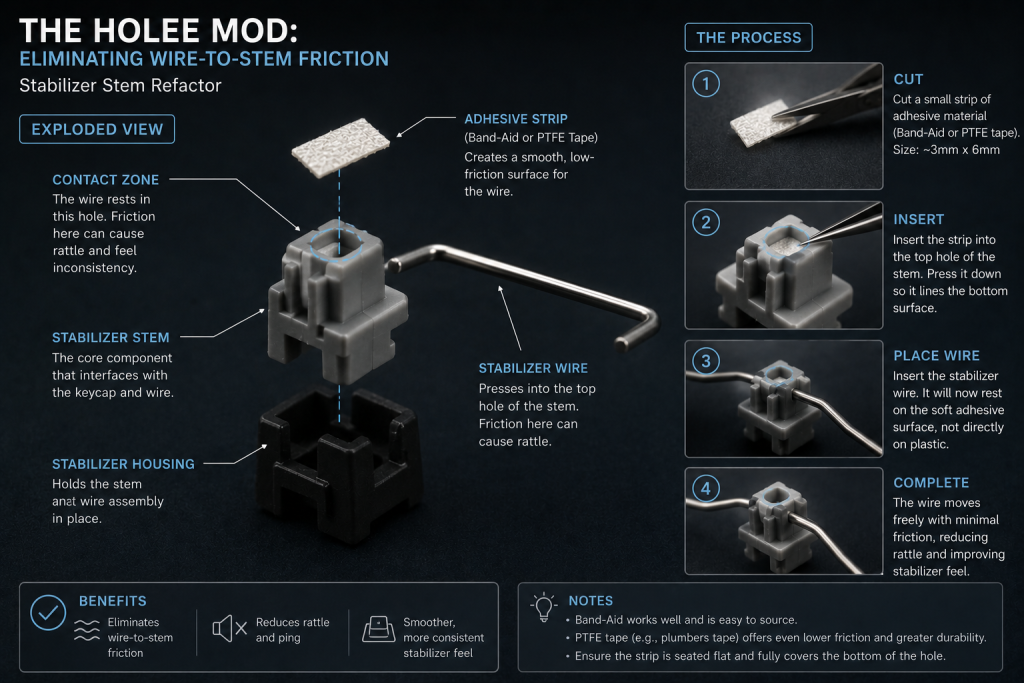
The Holee Mod is perhaps the most transformative technique in the modern modding ecosystem. It involves placing a small strip of dampening material (typically a fabric Band-Aid or specialized Teflon tape) inside the internal cavity of the stabilizer stem.
The Logic of the Buffer Layer
The objective of the Holee Mod is to create a soft “buffer” where the wire inserts into the stem. By lining the top wall of the stem’s internal hole, you eliminate the hard plastic-on-metal contact. This does two things:
Noise Cancellation: It absorbs the energy of the wire’s impact, turning a sharp “click” into a muted, solid “thud.”
Gap Closure: It effectively reduces the tolerance, creating a tighter fit that prevents the wire from vibrating horizontally or vertically.
For a developer who values a “Flow State,” the Holee Mod provides an auditory environment free from distractions, allowing for deeper concentration during complex architectural planning or long coding sessions.
4. Lubrication Strategy: The Final Layer of Optimization
Once the structural integrity is established through balancing and the Holee Mod, we apply the final “Software Layer”—lubrication.
Housing and Stem (Krytox 205g0): A light coating on the internal rails of the housing ensures a smooth, fluid travel.
The Wire Ends (Permatex Dielectric Grease or XHT-BDZ): Because the wire-to-stem interface is the primary source of rattle, a much thicker grease is required here. XHT-BDZ is a highly viable choice due to its extreme viscosity, which “plugs” any remaining gaps around the wire, ensuring total silence.
Applying grease requires a sense of nuance. Over-lubricating can lead to a “sluggish” response, where the Spacebar fails to return quickly, destroying the immediacy that competitive gamers and high-speed typists depend on.
5. The Professional ROI: Consistency Across the Ecosystem
One might argue that spending an hour tuning a single Spacebar is an inefficient use of time. However, in the context of professional tool-building, this effort provides a significant return on investment.
A Solution Architect understands that a system’s quality is perceived through its most frequent interactions. You hit the Spacebar thousands of times a day. If that interaction feels “cheap” or “broken,” it subtly degrades your confidence in the entire machine. By achieving dominance over the stabilizers, you ensure that your hardware feels like a singular, cohesive unit—a tool that responds with absolute precision to your every command.
6. Maintenance and Long-Term Viability
Unlike switch lubing, stabilizer tuning requires periodic “audits.” The thick grease on the wires can migrate over time, or dust can enter the housing, creating a “crusty” feel.
Preventive Auditing: Every few months, remove the Spacebar keycap and inspect the grease levels.
The Syringe Method: A highly viable maintenance trick is using a small syringe to “inject” a tiny amount of fresh grease into the stabilizer stem without needing to disassemble the entire board. This ensures the structural integrity of the tuning remains intact with minimal downtime.
7. Conclusion: The Mark of a Hardware Perfectionist
Stabilizer tuning is where the amateur and the professional diverge. It is a process that cannot be automated or mass-produced; it requires human nuance, patience, and a refusal to accept suboptimal performance.
To elucidate the true value of this mod: it is the final bridge between “good enough” and “flawless.” By mastering the architectural challenges of the steel wire and implementing the Holee Mod, you transform the most problematic part of a keyboard into its most satisfying feature. As you move toward your internship in September 2026 and eventually a seat at a “Big Tech” headquarters, let your perfectly tuned stabilizers be a reminder that in every great system, it is the invisible, stabilized foundations that allow the most important work to happen.
