Maintenance & Technical Guides
The Art of Switch Lubing: Friction Modification and the Logic of Smoothness
May
In the rigorous discipline of system design, engineers constantly seek to eliminate “noise”—any inefficient friction that degrades the overall performance of a system. When translating this concept to the physical realm of computer peripherals, the mechanical switch is the primary node of interaction. Out of the factory, even the most premium switches suffer from micro-abrasions between moving plastic parts. The practice of “Switch Lubing” is not merely a hobbyist trend; it is a profound paradigm shift in hardware optimization. By applying specific synthetic lubricants, one can fundamentally alter the acoustic and tactile properties of a keyboard. This article will elucidate the architectural mechanics of switch lubing, proving why modifying friction is the most viable method to achieve absolute typing dominance.
1. The Tribology of the Switch: Understanding System Friction
To understand why lubrication is integral to a premium typing experience, one must first examine the switch’s internal architecture. A standard mechanical switch consists of a stem (often made of POM plastic) sliding inside a housing (typically Polycarbonate or Nylon) and compressing a metal spring.
Whenever two unlubricated surfaces interact, they create kinetic friction. In a keyboard switch, this manifests as “scratchiness”—a physical resistance that you can feel, accompanied by a high-pitched, papery sound. From an engineering standpoint, this friction is inefficient. It disrupts the tactile immediacy of the keystroke. By introducing a chemical lubricant, we create a microscopic fluid boundary layer between the plastics. This layer prevents direct plastic-on-plastic contact, preserving the structural integrity of the switch components while transforming the kinetic resistance into a seamless, fluid motion.
2. Selecting the Right Logic: The Lubricant Ecosystem
The world of switch lubrication relies on a very specific ecosystem of synthetic chemicals. Using general-purpose oils (like WD-40 or machine oil) is a catastrophic error that will degrade the plastics and ruin the hardware. The industry standard relies on fluorinated polymers, most notably the Krytox and Tribosys series.
Choosing the correct viscosity is a vital nuance of the process:
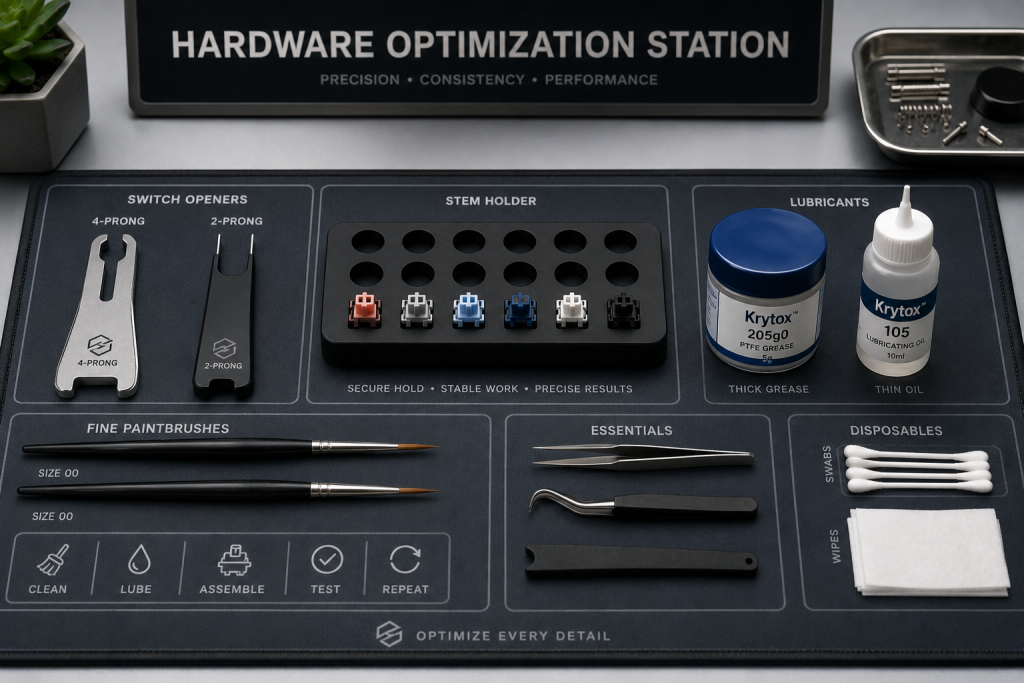
Krytox 205g0 (Grade 0): This is a thick, buttery grease. It is the absolute standard for Linear switches. Its thick viscosity aggressively dampens high-pitched sounds, creating a deep, resonant acoustic profile known as “Thock.”
Tribosys 3203 / 3204: These are thinner lubricants. They are the most viable options for Tactile switches. Because they are less viscous, they smooth out the travel without completely masking the tactile bump that users rely on for feedback.
Krytox 105 Oil: A highly fluid oil used almost exclusively for lubricating the internal metal springs to eliminate metallic “pinging” sounds.

3. The Execution Protocol: The “Less is More” Methodology
The most common mistake novices make is applying too much grease. In system architecture, over-engineering often leads to bottlenecks; in switch lubing, over-lubrication leads to a “mushy” feeling, completely destroying the switch’s immediacy and causing the stem to stick. The golden rule is: If you can clearly see a white glob of grease, you have applied too much. The goal is to create a microscopic, glistening film.
Step 1: The Bottom Housing and Rails
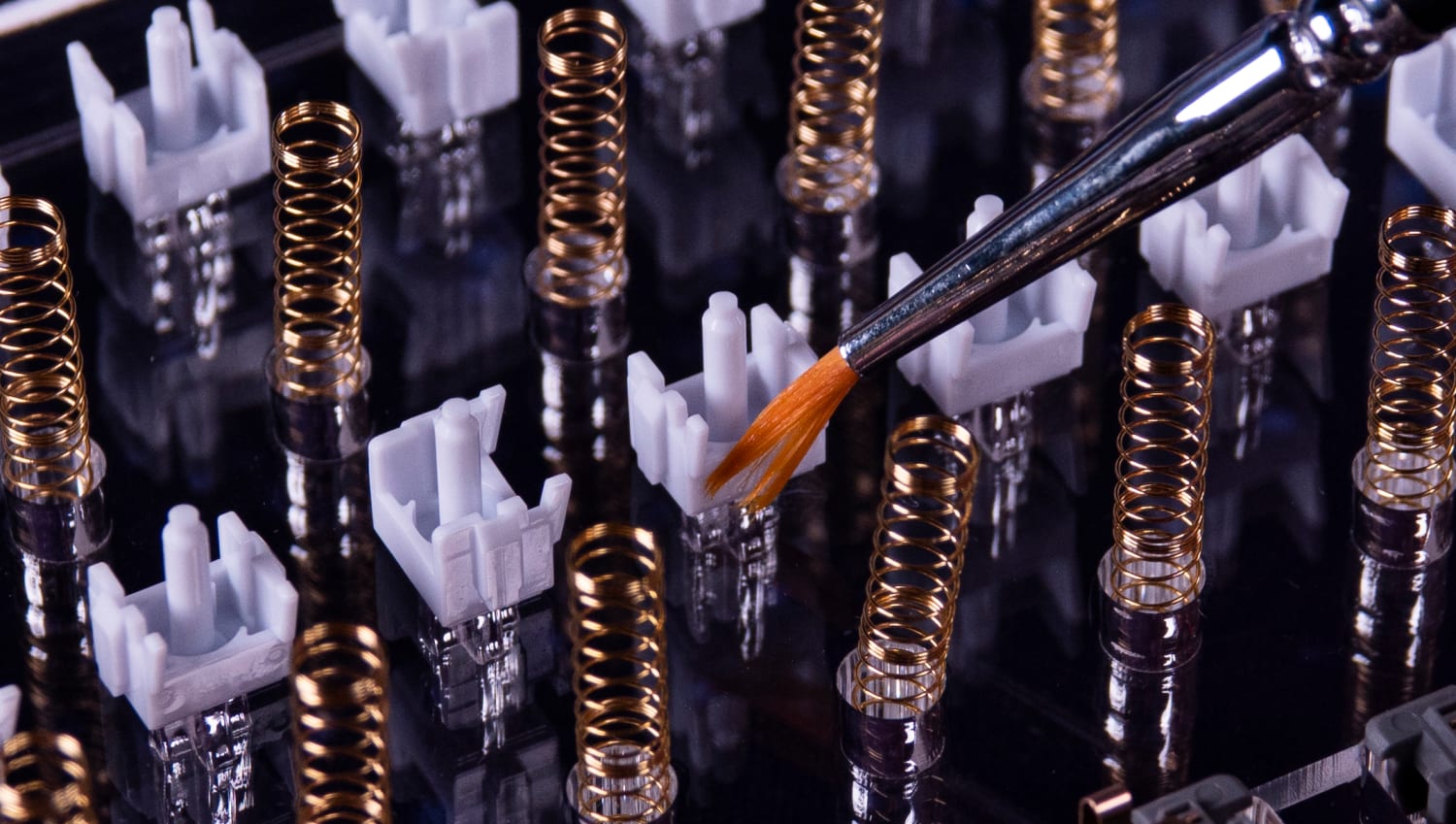
Open the switch and isolate the bottom housing. Dip the tip of your brush lightly into the 205g0. Apply a razor-thin layer to the two vertical slider rails inside the housing. These rails dictate the primary path of the stem. Also, lightly brush the cylindrical center pole where the spring rests to prevent friction at the base.
Step 2: Spring Dynamics (Bag Lubing vs. Donut Dipping)
Spring ping is a highly distracting acoustic artifact. There are two viable methods to resolve this:
Bag Lubing: Place all the springs into a small plastic bag with a few drops of Krytox 105 oil. Inflate the bag and shake vigorously. This coats the springs in an even, micro-thin layer of oil, instantly silencing them.
Donut Dipping: For those using 205g0, dip just the top and bottom ends of the spring into the grease. This dampens the contact points where the spring meets the plastic housings.
Step 3: The Stem Optimization
The stem is the most integral component of the lubing process. Using the stem holder, carefully brush the lubricant onto the side rails of the stem.
Here, an important nuance arises depending on the switch type:
For Linear Switches: You can also lightly brush the “legs” of the stem (the parts that contact the metal leaf) to achieve maximum smoothness.
For Tactile Switches: Never lube the stem legs. The friction between the legs and the metal leaf is precisely what creates the tactile bump. Lubing this area will erase the switch’s defining characteristic, turning a premium tactile switch into a sluggish linear one.
4. The ROI (Return on Investment) of Hardware Refactoring
Lubricating a keyboard with 80 to 100 switches can take upwards of three to four hours. From a high-level perspective, one might question if this tedious manual labor is a viable use of time for a busy professional.
The answer lies in the concept of compounding efficiency. A software developer or systems architect performs tens of thousands of keystrokes a day. If every single keystroke is accompanied by acoustic noise and kinetic friction, the cumulative “system fatigue” on the user’s focus and hands is immense.
By taking the time to manually refactor the physics of the switch, you create an input device of unparalleled dominance. The keyboard transcends its factory limitations, offering an immediacy and sensory satisfaction that cannot be bought off a retail shelf.
5. Conclusion: The Mark of a Hardware Artisan
Switch lubing is the ultimate expression of taking control over one’s digital ecosystem. It requires patience, precision, and a deep understanding of how micro-mechanics influence macro-performance.
To elucidate the value of this practice: it is the difference between writing functional code and writing perfectly optimized, elegant code. By mastering the architectural nuances of friction modification, you not only preserve the structural integrity of your hardware but elevate it to a standard of absolute perfection.
