Maintenance & Technical Guides
Switch Filming and Housing Tolerances: Optimizing Structural Stability for Peak Performance
May
In the precise world of hardware engineering, the difference between a “good” component and a “masterpiece” often lies in the tolerances—the allowable limits of variation in physical dimensions. In the mechanical keyboard ecosystem, even the most reputable switches can suffer from “Housing Wobble,” a subtle instability where the top and bottom halves of the switch do not meet with absolute firmness. For a professional striving for dominance in their digital workspace, this wobble represents a form of mechanical noise that disrupts the immediacy of the typing experience. This article will elucidate the practice of Switch Filming, demonstrating how this minor architectural intervention can fundamentally enhance the structural integrity and acoustic clarity of your hardware.
1. The Logic of Tolerance: Why “Wobble” is a System Bug
To a Solution Architect, any unintended movement in a system is a sign of inefficiency. Mechanical switch housings are mass-produced using injection molding. Due to the nature of this manufacturing process, there must be a slight gap (tolerance) to ensure the two plastic halves can be snapped together easily.
However, when these tolerances are too loose, the top housing can shift slightly when a key is pressed. This results in:
Acoustic Artifacts: The loose housing vibrates, creating a high-pitched “clack” or “rattle” that masks the intended sound of the switch.
Tactile Inconsistency: The minor shift in the housing can alter the travel path of the stem, subtly degrading the immediacy of the actuation.
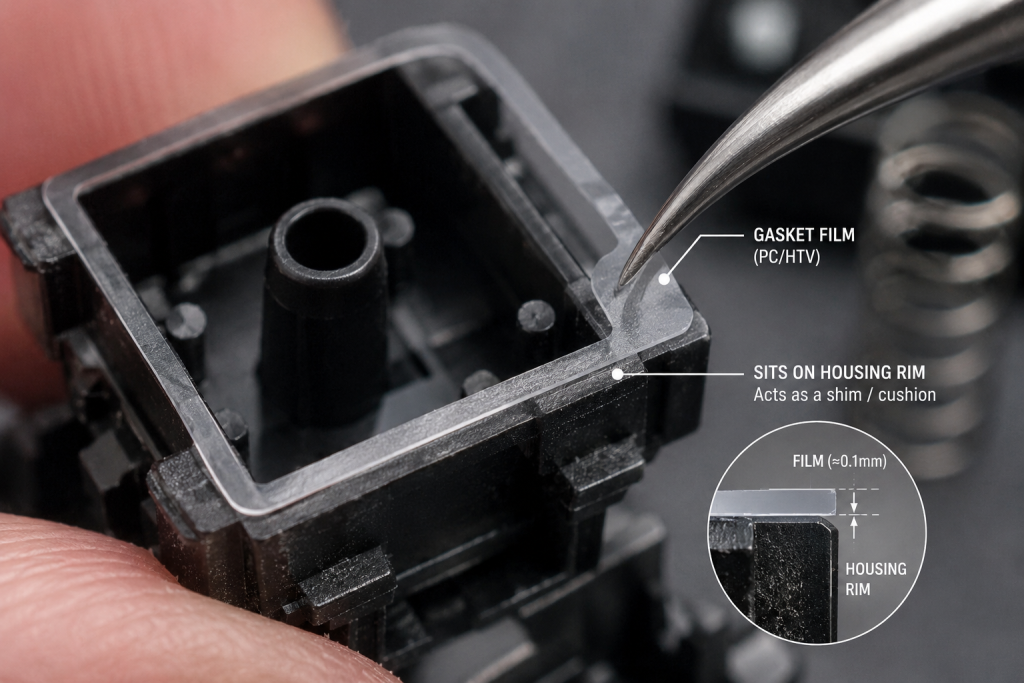
Switch filming is the process of “refactoring” this physical interface, using a thin gasket to fill the gap and restore absolute structural integrity to the component.
2. The Film Ecosystem: Analyzing Material Nuance
Just as different programming languages are suited for different tasks, the material and thickness of a switch film must be chosen based on the specific nuances of the switch housing.
PC (Polycarbonate): These are rigid films. They are the most viable option for switches with very small gaps. Because they do not compress much, they provide a very “solid” feel and a sharper acoustic profile.
HTV + Polycarbonate (Hybrid): These films feature a soft, compressible layer (HTV) on one side and a rigid layer on the other. This hybrid architecture is excellent because it conforms to any irregularities in the plastic housing, ensuring a perfect seal.
Poron/Foam Films: These are the thickest and most compressible. They are ideal for switches with massive tolerances (like older Cherry MX molds), acting as a “muffler” that significantly deepens the sound.
Choosing the wrong thickness is a common error. A film that is too thick will prevent the switch from closing properly, which can interfere with its viability within a plate.
3. The Acoustic Paradigm Shift: From “Clack” to “Thock”
One of the primary reasons enthusiasts and professionals perform switch filming is to achieve a specific “Sonic Identity.” By tightening the housing, you effectively change the resonance of the switch.
A filmed switch typically exhibits a much deeper, more concentrated sound profile. This is because the vibration is no longer dispersed through a loose plastic joint but is instead channeled through a solid, unified structure. For a developer working in a quiet office or a student at FPT Polytechnic Danang, this improved acoustic profile reduces auditory fatigue during long coding marathons, allowing for a more sustained “Flow State.” The dominance of the low-frequency “thock” sound is often the hallmark of a truly high-end, optimized keyboard.
4. Stability and Tactile Immediacy
Beyond the sound, filming has a profound impact on the “Feel” of the keyboard. When the housing is perfectly stable, the stem travels in a more predictable, linear path.
This stability is integral to high-speed typing and competitive gaming. In a high-stakes match of Counter-Strike 2 or Valorant, the immediacy of a keypress is paramount. Any “mushiness” or physical inconsistency caused by a shifting housing can lead to missed inputs. Filming ensures that the switch feels like a singular, robust tool rather than a collection of moving parts. It provides the structural integrity required for a professional-grade interface.
5. The Execution Protocol: Precision at the Micro-Scale
Switch filming is a labor-intensive process that requires the same level of attention to detail as debugging a complex API.
Disassembly: Open the switch carefully to avoid damaging the plastic clips.
Placement: Using fine tweezers, place the film onto the rim of the bottom housing. It is of critical importance to ensure the film does not interfere with the metal contact leaf or the stem’s travel path.
Sealing: Snap the top housing back into place. You should hear a much firmer “click” than before, indicating that the tolerances have been successfully closed.
Testing: Once reassembled, wiggle the top housing. If the architectural intervention was successful, there should be zero movement between the two halves.
6. The Developer’s ROI: Is it Worth the “Technical Debt”?
Filming a full-sized keyboard (104 switches) can take several hours. From a Solution Architect’s perspective, we must ask: Is the return on investment (ROI) viable?
The answer is found in the longevity and quality of the interaction. If you spend 8 to 12 hours a day at your desk, the keyboard is your most frequently used piece of infrastructure. Small improvements in tactile immediacy and acoustic comfort compound over millions of keystrokes. By “refactoring” your switches through filming, you are essentially eliminating a form of hardware-level technical debt that would otherwise manifest as physical fatigue and mental distraction.
7. Strategic Implementation: Knowing When to Film
It is important to note that not all switches require filming. Modern “Big Tech” manufacturers like Kailh or Akko have made significant strides in their molding technology, creating “tight” tolerances that often make filming unnecessary.
Before committing to a full filming session, perform a “Tolerance Audit”:
Open one switch and reassemble it.
Try to move the top housing with your fingernail.
If you can feel or see movement, filming is an integral step for optimization.
If the housing is already rock-solid, adding a film might actually be counterproductive, potentially causing the switch to fit poorly in the plate.
8. Conclusion: The Master of Micro-Architecture
Switch filming is the ultimate expression of the “God is in the details” philosophy. It is a process that requires a refusal to accept “good enough” in favor of absolute perfection. By mastering the nuances of housing tolerances and material science, you elevate your keyboard from a mass-produced peripheral to a bespoke professional instrument.
To elucidate the true value of this mod: it provides a sense of absolute dominance over your physical tools. You have taken a standard component and improved its structural integrity at a microscopic level. As you continue your path toward a career in software engineering and prepare for your internship in September 2026, let your filmed switches be a reminder that in any great system—whether it is a codebase or a keyboard—the most significant improvements often come from optimizing the smallest, most invisible foundations.
