Brand Legacy & Market Impact
Leopold & Filco: The Cult of Minimalism and the Sovereign of Structural Integrity
May
In an era characterized by excessive sensory input and aggressive “gamer” marketing, a significant paradigm shift has quietly occurred within the high-end professional community. While mainstream brands compete in an “RGB arms race,” a dedicated segment of software engineers, writers, and Solution Architects has returned to the “Old Guard.” Leopold and Filco—hailing from South Korea and Japan, respectively—stand as the twin pillars of this movement. They do not seek to dazzle with software or lights; instead, they have established market dominance through an uncompromising devotion to structural integrity and tactile perfection. This article will elucidate the legacy of these East Asian titans and analyze why their minimalist architecture remains the most viable choice for the digital professional in 2026.
1. The Japanese Philosophy of Reliability: The Filco Legacy
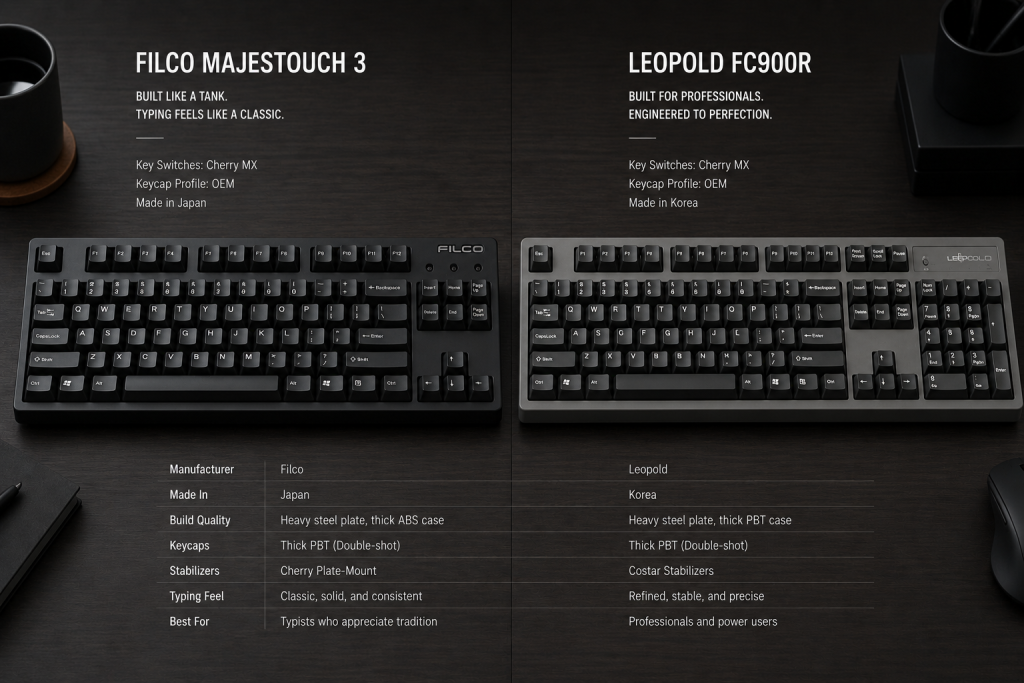
Founded by the Diatec Corporation in Japan, Filco is the embodiment of the “Kaizen” philosophy—continuous, incremental improvement toward a perfect standard. Their flagship series, the Majestouch, has remained virtually unchanged in appearance for nearly two decades. To a casual observer, this may seem like a lack of innovation; however, for a developer at a “Big Tech” firm, this consistency is the ultimate feature.
The Structural Integrity of the FR-4 PCB
The dominance of Filco is rooted in its internal architecture. While budget boards use thin, single-layer PCBs, Filco utilizes high-quality, dual-layer FR-4 glass epoxy circuit boards. This choice is integral to the typing experience, as it ensures that the electrical signal maintains its immediacy and that the board remains rigid under heavy use. Filco’s commitment to internal quality over external flash is a masterclass in “Invisible Engineering”—building a system that is so robust that the user never has to think about its failure.
Costar Stabilizers and Tactile Immediacy
One technical nuance that separates Filco from its competitors is its continued use of Costar-style stabilizers. Unlike the more common Cherry-style stabilizers which can feel “mushy,” Costar stabilizers provide a crisp, direct feedback that preserves the raw immediacy of the switch’s actuation. For a student at FPT Polytechnic or a professional Solution Architect, this clarity of feedback is essential for maintaining a high-speed “flow state” during complex coding sessions.
2. The South Korean Precision: The Leopold Standard
If Filco represents the soul of Japanese engineering, Leopold represents the peak of South Korean manufacturing precision. Leopold has carved out its dominance by focusing on the “End-State” of the typing experience: the interaction between the finger and the keycap.
The Golden Ratio of Keycaps
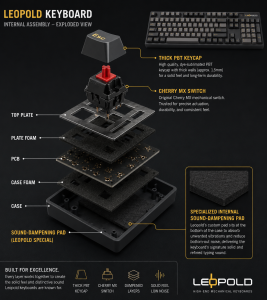
Leopold is credited with popularizing the high-quality Double-shot PBT keycap as a standard feature. Their keycaps are significantly thicker (1.5mm) than the industry average, providing a heavy, dampened sound that enthusiasts refer to as “thocky.” This focus on material nuance is not merely aesthetic; PBT is a more durable polymer that does not develop a “greasy shine” over time, ensuring the keyboard’s viability and professional appearance for years.
The Sound Dampening Pad: An Architectural Innovation
Long before “sound-dampening foam” became a trend in the custom keyboard world, Leopold was already integrating a specialized sound-absorbing pad inside their cases. This was a true paradigm shift in mass-produced hardware. By neutralizing internal echoes and high-pitched vibrations, Leopold created a typing experience that is as quiet as it is tactile. This focus on “Acoustic Integrity” makes Leopold an integral tool for professionals working in open-office environments who require the performance of a mechanical board without the disruptive noise.
3. The Power of “No Software”: A Strategic Choice
In the world of system architecture, we often say that “Complexity is the enemy of reliability.” Both Filco and Leopold follow this logic by offering zero software. There are no cloud-based drivers to install, no firmware updates that can brick the device, and no background processes to consume CPU resources.
This lack of software is a vital part of their viability. By utilizing physical DIP switches on the bottom of the board to change key functions (such as swapping Caps Lock with Ctrl), they ensure that the keyboard’s logic is saved directly to the hardware. For a Solution Architect, this hardware-level persistence is the gold standard: the tool works exactly the same way whether it is plugged into a Windows server, a Linux terminal, or a MacBook Pro. It is a “Plug-and-Play” experience in its purest, most professional form.
4. Why Minimalist Keyboards Outlast the “Gaming” Titans
You might wonder how these “basic” boards maintain their market dominance in 2026. The answer lies in the concept of Architectural Sustainability. Gaming keyboards are often designed to be replaced every three to five years as new lighting trends or sensor technologies emerge.
In contrast, a Filco or a Leopold is designed for a decade of service. Their designs are “Static,” but their quality is “Dynamic.” By using standard layouts and high-grade materials, these brands have ensured that their products remain integral parts of a user’s desk for as long as the USB protocol remains viable. In an industry obsessed with the “New,” Leopold and Filco have found success by mastering the “Eternal.”
5. The Developer’s Nuance: Typing as a Sensory Ritual
As a student of Software Development, your primary interface with your logic is the keyboard. If the interface is “noisy”—whether through rattling stabilizers or distracting lights—it creates friction in your thinking process.
Filco and Leopold remove this friction. The structural integrity of their chassis and the nuance of their keycaps create a sensory ritual that signals to the brain: “It is time to build.” The immediacy of a Filco’s click or the dampened “thock” of a Leopold’s bottom-out provides a tactile rhythm that aids in critical thinking and complex problem-solving. This is why you will often see these boards on the desks of the most respected senior engineers at firms like Google or Facebook.
6. The Solution Architect’s Final Analysis
From a system design perspective, Filco and Leopold are perfect examples of “Singular Purpose Optimization.” They do not try to be a media controller, a stream deck, or a decorative lamp. They aim to be the world’s best data entry tools.
By ignoring the paradigm shift toward flashy features and instead focusing on the nuances of build quality, these brands have achieved a level of “Brand Integrity” that marketing dollars cannot buy. They have proven that there is a permanent, high-value market for products that choose to do one thing—and do it better than anyone else on Earth.
7. Conclusion: The Master of Silence and Strength
The legacy of Leopold and Filco is a testament to the power of the “Reference Standard.” They are the keyboards that every other manufacturer looks to when they want to understand what a “Quality” board should feel like.
To elucidate their true impact: they gave us the “Standard of Truth.” By prioritizing structural integrity, tactile immediacy, and professional viability, they have ensured that the minimalist mechanical keyboard remains an integral weapon in the professional’s arsenal. As you prepare for your internship in September 2026 and continue your journey toward becoming a Solution Architect, let Leopold and Filco serve as your guiding light: build your systems with the same quiet strength and uncompromising quality. Sometimes, the most powerful statement you can make is the one you make in silence.
