Brand Legacy & Market Impact
IBM & Lenovo: The Eternal Blueprint and the Legacy of the Model M
May
In the rapidly shifting landscape of modern technology, where products are often designed for planned obsolescence, certain artifacts stand as defiant monuments to timeless engineering. The IBM Model M, introduced in 1984, is not merely a keyboard; it is the “Godfather” of the mechanical world. As a student at FPT Polytechnic Danang or a future Solution Architect, understanding the legacy of IBM and its successor, Lenovo, is crucial to mastering the concept of architectural longevity. This article will elucidate how IBM orchestrated the first great paradigm shift in input devices and how the structural integrity of their designs continues to dominate the technical standards of 2026.
1. The Genesis of the Standard: IBM and the Birth of the PC
To understand the dominance of the Model M, one must look at the state of computing in the early 1980s. IBM was the primary architect of the personal computer revolution. When they released the IBM PC, they didn’t just sell a machine; they established a global ecosystem. The Model M was the integral interface of this ecosystem.
IBM’s philosophy was simple but profound: a professional tool must provide absolute immediacy in feedback. Before the era of silent membrane keys, IBM understood that a typist—or a programmer—required a tactile “confirmation” of every keystroke to maintain peak efficiency. This focus on the “Logic of Tactility” is what allowed the Model M to become the universal benchmark for every mechanical keyboard that followed.
2. The Buckling Spring: A Masterclass in Mechanical Logic
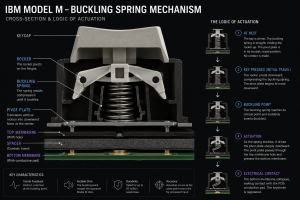
The defining feature of the Model M is the Buckling Spring mechanism. Unlike modern Cherry MX switches, which use a vertical plunger, the buckling spring utilizes a physical coil spring that collapses (buckles) under pressure.
Elucidating the Physics of Feedback
As a software developer, you can appreciate the “binary” nature of this design. The spring resists until it reaches a specific threshold, at which point it buckles, causing a pivot plate to strike a contact and producing a loud, distinctive “click.” This provides both auditory and tactile immediacy. There is no ambiguity; you know the exact microsecond the signal is sent to the CPU.

Structural Integrity as a Feature
The internal architectural design of the Model M was over-engineered by modern standards. It featured a curved steel backplate that was nearly 1.5mm thick, providing a level of structural integrity that made the keyboard virtually indestructible. This is why Model M units found in basements 40 years later are still viable tools for coding in 2026. IBM didn’t build for a three-year upgrade cycle; they built for a lifetime of professional use.
3. The Paradigm Shift: Defining the 101-Key Layout
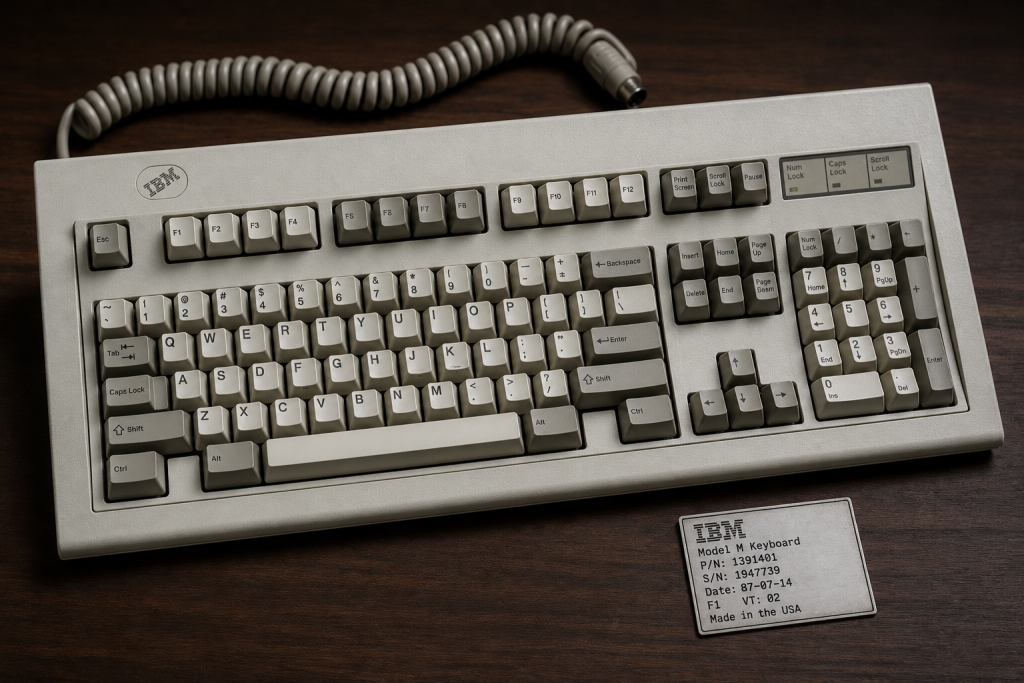
Perhaps IBM’s most enduring market impact is the standardization of the keyboard layout. The Model M introduced the “Enhanced Layout” with 101 keys, featuring the inverted-T arrow keys, the dedicated function row, and the navigation cluster.
Before the Model M, keyboard layouts were a chaotic mess of competing designs. IBM’s dominance forced a worldwide paradigm shift, creating a standard that has remained largely unchanged for four decades. For a Solution Architect, this is a classic example of a “Standardization Success Story”—creating a framework so robust and logical that the entire industry has no choice but to adopt it as the default “Source of Truth.”
4. The Lenovo Transition: Carrying the ThinkPad Torch
In 2005, IBM made the strategic decision to sell its personal computing division to Lenovo. Many feared that the legacy of the Model M and the “IBM Quality” would be lost. However, Lenovo understood the nuance of the brand’s identity.
They successfully transitioned the IBM keyboard DNA into the ThinkPad line of laptops. The “ThinkPad Keyboard” became the only viable choice for developers who needed a mechanical-like feel in a mobile form factor. By maintaining the tactile immediacy and the iconic “TrackPoint,” Lenovo ensured that the professional ecosystem IBM built remained intact. This shows that the viability of a brand legacy depends on its ability to adapt its core “Architecture” to new form factors without sacrificing its fundamental values.
5. The Market Impact: Inspiring the Custom Revolution
The current $2 billion mechanical keyboard market owes its existence to the Model M. When the world was flooded with cheap, “mushy” rubber dome keyboards in the late 90s, a small group of enthusiasts refused to let the Model M die. This resistance sparked the “Mechanical Renaissance.”
Modern custom keyboards, with their focus on “Thock,” weighted plates, and high-quality PBT keycaps, are essentially attempts to replicate the structural integrity and sensory satisfaction of the original IBM design. Even the most expensive “Group Buy” custom board is, in many ways, an homage to the architectural foundation laid by IBM. The Model M proved that the typing experience is a nuance worth paying for—a lesson that every premium brand from Razer to Keychron has since built their business upon.
6. The Developer’s Perspective: A Tool for Critical Thinking
As a student at FPT Polytechnic preparing for a career in “Big Tech,” you might wonder why a 40-year-old keyboard matters. The answer lies in the “Flow State.” Programming is an exercise in complex logic and extreme focus. The heavy, tactile response of a Model M acts as an anchor for your thoughts.
The immediacy of the buckling spring reduces input errors, allowing you to write code with a level of confidence that “soft” keyboards cannot provide. For a Solution Architect, your tools should never be a source of friction. The Model M was the first keyboard to be designed as a truly “frictionless” interface for the professional mind—a goal that remains the integral objective of every high-end peripheral in 2026.
7. The Viability of “Old Tech” in a New World
In an era of wireless, RGB, and ultra-thin profiles, the Model M remains a viable solution through companies like Unicomp, which still uses the original IBM tooling to produce “New Model M” boards. This proves that a truly great “Architecture” never becomes obsolete; it simply becomes a “Classic.”
The legacy of IBM and Lenovo teaches us that dominance is not achieved through trends, but through the relentless pursuit of quality. By mastering the structural integrity of the hardware and the nuance of the user experience, IBM created a product that transcended its era.
8. Conclusion: The Master Architect’s Legacy
The IBM Model M is the ultimate blueprint for the mechanical world. It orchestrated a paradigm shift that defined the way we interact with computers, and its structural integrity set a standard that has yet to be surpassed in terms of pure longevity.
To elucidate the brand’s true impact: IBM didn’t just build a keyboard; they built a legacy of precision. As you continue your path toward becoming a Solution Architect, let the Model M serve as your inspiration. Aim to build systems that are so logical, so robust, and so integral to the user’s workflow that, forty years from now, the next generation of developers will still be using your “Blueprint” as their standard.
