Brand Legacy & Market Impact
Luxury Cherry: The Bedrock of Mechanical Evolution and the Gold Standard of Engineering
May
In the realm of computer hardware, some brands are defined by their flashy marketing, while others are defined by their structural integrity and foundational influence. Cherry, a German-American manufacturer, belongs firmly in the latter category. For over half a century, Cherry has acted as the silent architect of the mechanical keyboard world, establishing a technical framework that remains the industry’s “Source of Truth.” To elucidate the brand’s legacy is to explore the history of modern typing itself. This article analyzes the architectural brilliance of the Cherry MX switch and the strategic dominance that facilitated a global paradigm shift in peripheral design.
1. The Heritage of Precision: From Illinois to Auerbach
The story of Cherry is a rare hybrid of American entrepreneurship and German engineering excellence. Founded by Walter Cherry in 1953 in the basement of a Highland Park, Illinois restaurant, the company initially focused on microswitches for the automotive and appliance industries. However, the true paradigm shift occurred when the company moved its headquarters to Auerbach in der Oberpfalz, Germany, in the 1960s.
This move combined American innovative spirit with the rigorous “Mittelstand” engineering philosophy of Germany. The result was a brand that prioritized structural integrity above all else. While other manufacturers were seeking the cheapest way to mass-produce rubber dome membranes, Cherry remained committed to mechanical logic—a decision that would eventually ensure their long-term viability when the market rediscovered the value of tactile feedback.
2. The Architectural Marvel: The Cherry MX Switch
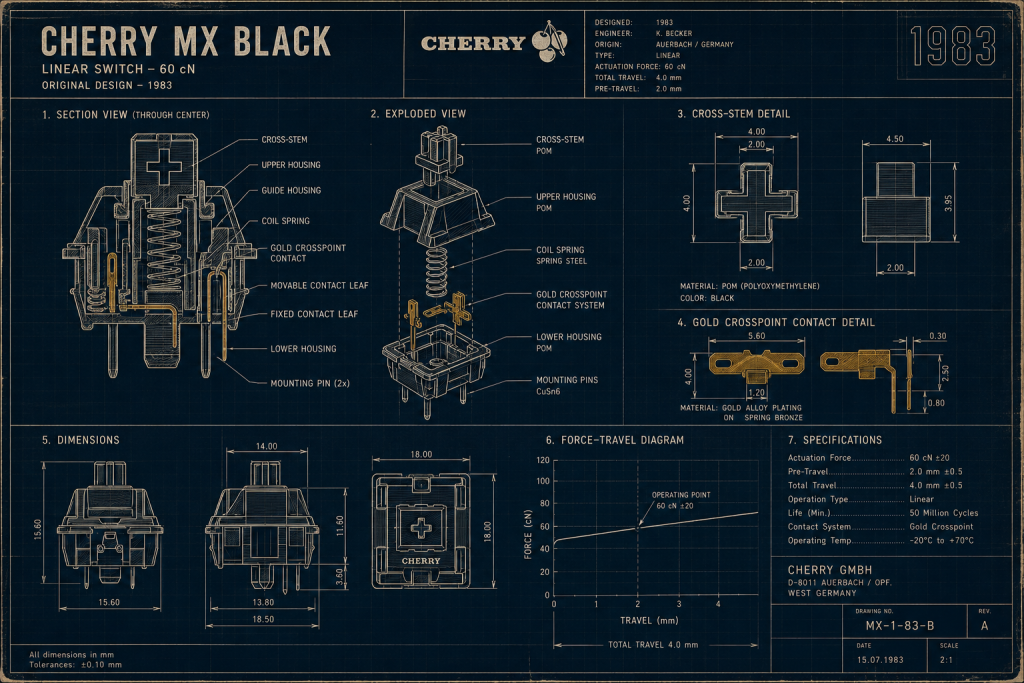
In 1983, Cherry introduced the MX (Mechanical X-Point) switch, a component that would become the most integral building block in keyboard history. As a future Solution Architect, you can appreciate the beauty of the MX design: it is a modular, self-contained system that provides a consistent interface (the cross-stem) while allowing for internal nuance in feel.
The Gold-Crosspoint Contact
The genius of the MX switch lies in its internal contact system. Cherry utilized high-purity gold for its crosspoint contacts. This choice was not about luxury; it was about technical viability. Gold does not oxidize, ensuring that the electrical signal maintains its immediacy over tens of millions of actuations. This engineering choice is why Cherry keyboards from the 1980s are still functional today, proving that a robust underlying architecture is the key to system longevity.
The “Color” Standard
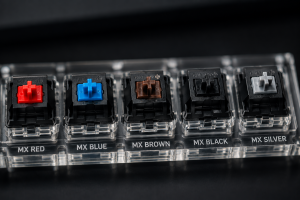
Cherry did more than just build a switch; they created a universal language for the industry. By color-coding their switches—Red for linear, Blue for clicky, Brown for tactile—they simplified the complex physics of actuation for the end-user. This categorization is a masterclass in UX design, allowing users to understand the “Logic” of their hardware at a single glance.
3. Market Dominance and the “Cross-Stem” Ecosystem
The most significant impact Cherry has had on the market is the standardization of the “Cross-Stem.” If you look at almost any mechanical keyboard in 2026, the keycaps are held in place by a cross-shaped stem—a design pioneered by Cherry.
By allowing this design to become the industry standard, Cherry created a massive ecosystem of third-party keycaps. This dominance was so absolute that even when their patents expired, the “Cherry Profile” and “Cherry Stem” remained the default requirement for any viable keyboard product. In software terms, Cherry created the “Kernel” of the keyboard world, and every other brand is simply building an “API” or “UI” on top of it.
4. Surviving the Patent Expiration: A Lesson in Brand Equity
When Cherry’s original patents expired in the 2010s, the market was flooded with “clones” from manufacturers like Gateron, Kailh, and Outemu. Many analysts predicted that Cherry’s dominance would crumble under the weight of cheaper alternatives. However, the opposite occurred.
Cherry leaned into its reputation for structural integrity. While clones often suffered from “stem wobble” or inconsistent actuation, Cherry doubled down on its German manufacturing standards. They introduced the MX Silent and MX Speed Silver to address the immediacy required by the growing eSports market. By positioning themselves as the “Premium Original,” Cherry ensured that having “Original Cherry Switches” remained a powerful marketing badge for high-end brands like Corsair and Filco.
5. The Enthusiast Nuance: Why Cherry Still Matters
In the modern custom keyboard community, there is a recurring debate about whether newer, “smoother” switches have rendered Cherry obsolete. However, veteran enthusiasts often return to Cherry MX Blacks (especially the “Vintage” or “Hyperglide” variants) for their specific acoustic profile.
For a student at FPT Polytechnic or a professional developer, the “Cherry Sound” represents a level of auditory nuance that signifies quality. The housing material—a proprietary nylon blend—produces a deep, muted sound that many find less fatiguing than the high-pitched “clack” of modern polycarbonate clones. This focus on the “Acoustic Architecture” shows a brand that understands that a keyboard is a sensory tool, not just a data-entry device.
6. The Developer’s Logic: Reliability as a Feature
From a Software Development perspective, Cherry switches are the hardware equivalent of a “Stable Release.” When you are coding for hours, you need a level of immediacy and predictability. You need to know that every time you hit Ctrl+S, the switch will actuate at exactly the same point with exactly the same force.
Cherry’s commitment to tight tolerances ensures that there is no “input noise” in your workflow. For a Solution Architect, this predictability is the most integral part of any system. Whether you are building a microservices architecture or a mechanical keyboard, the reliability of the lowest-level components determines the success of the entire project.
7. Conclusion: The Architect’s Eternal Legacy
Cherry is more than just a component manufacturer; it is the foundation upon which the entire $2 billion mechanical keyboard industry was built. They orchestrated the paradigm shift from disposable office gear to high-performance mechanical tools.
To elucidate Cherry’s true impact: they gave the industry its “Skeleton.” By mastering the structural integrity of the switch and establishing a universal ecosystem through the cross-stem design, they ensured their viability for over 70 years. As you continue your studies and move toward your goal of working at a “Big Tech” firm, let Cherry serve as a reminder: if you build the best foundation, the rest of the world will build on top of you.
