
Brand Legacy & Market Impact
Logitech: The Architect of Precision and the Evolution of eSports Dominance
May
In the intricate tapestry of the technology industry, few entities have demonstrated the endurance and adaptability of Logitech. While many brands flash brightly and fade into obsolescence, this Swiss-founded titan has orchestrated a masterclass in market longevity. From its humble origins as a manufacturer of office peripherals to its current status as the backbone of the professional eSports circuit, Logitech has consistently managed to elucidate the evolving needs of the digital user. This article analyzes the brand’s legacy, exploring how its commitment to structural integrity and technical innovation has facilitated a significant paradigm shift in our interaction with computing hardware.
1. The Swiss Foundation: Reliability as a Core Tenet
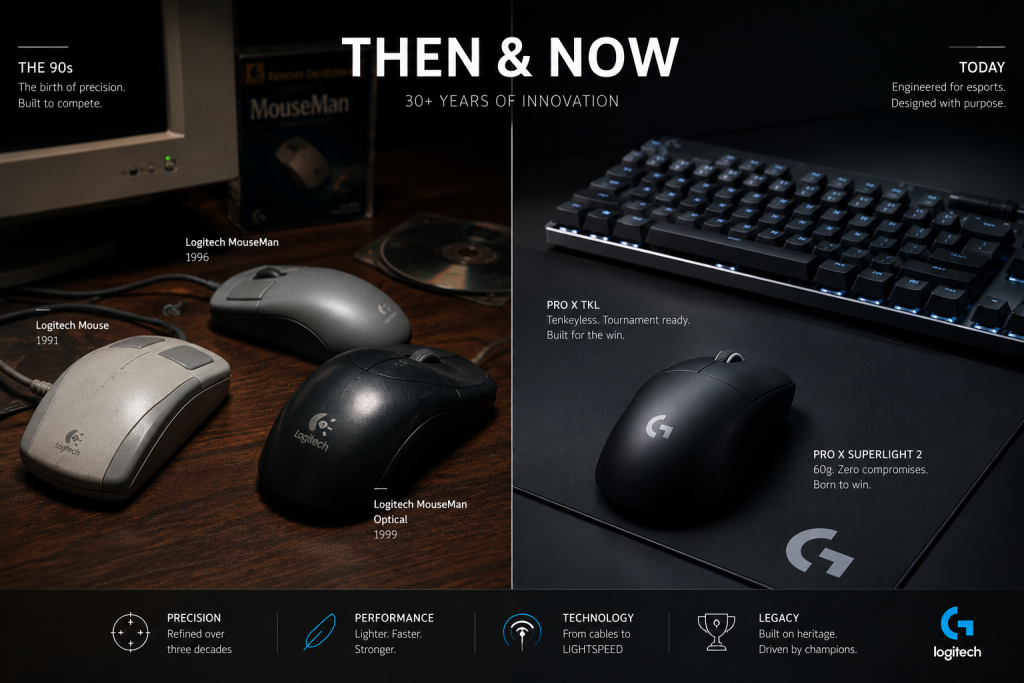
The story of Logitech is fundamentally a story of engineering. Founded in Apples, Switzerland, in 1981, the company did not initially set out to conquer the gaming world. Instead, it focused on the viability of the mouse as a primary interface tool—a concept that was still in its infancy. Unlike many of its contemporaries who prioritized aesthetic flair, Logitech’s early dominance was built upon a foundation of Swiss precision.
Every product released during this formative era was designed with a focus on structural integrity. This reputation for reliability became an integral part of the brand’s identity. For the professionals of the 80s and 90s, a Logitech peripheral was not just a purchase; it was a long-term investment in productivity. This “utility-first” philosophy would later become the secret weapon that allowed Logitech to survive where others failed when the market began to fragment.
2. The Strategic Pivot: The Birth of Logitech G
As the 2010s approached, the industry witnessed a massive surge in competitive gaming. Logitech recognized that the generic office mouse, while reliable, lacked the immediacy required for high-stakes competition. To address this, they launched Logitech G—a dedicated sub-brand focused exclusively on gaming performance.
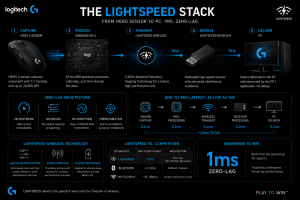
This was more than just a marketing rebrand; it was an architectural overhaul of their product development logic. Logitech G began to invest heavily in sensor technology, leading to the creation of the HERO (High Efficiency Rated Optical) sensor. This innovation was a paradigm shift for the industry. By providing top-tier accuracy while consuming ten times less power than competitors, Logitech ensured that their wireless future was not only possible but technically superior. For a future Solution Architect, this move illustrates the importance of solving fundamental bottlenecks (power consumption and latency) before attempting to scale an ecosystem.

3. Lightspeed Technology: Redefining Wireless Immediacy
For years, the professional eSports community held a near-religious devotion to wired peripherals. The prevailing wisdom was that wireless technology was inherently flawed, suffering from interference and latency issues that made it unviable for pro play. Logitech shattered this consensus with the introduction of Lightspeed.
Lightspeed was not merely an incremental improvement; it was a revolutionary protocol designed to provide a wireless connection with the same—or better—immediacy as a wired one. By optimizing every layer of the communication stack, from the sensor to the USB dongle, Logitech achieved a 1ms report rate.
This technical achievement forced a worldwide paradigm shift. Suddenly, the world’s best Counter-Strike and League of Legends players were switching to wireless mice. Logitech’s ability to prove the viability of wireless in the most demanding environments on Earth cemented their dominance and left competitors scrambling to catch up.
4. The G Pro Philosophy: Minimalism as a Competitive Edge
While brands like Razer embraced RGB and aggressive “gamer” aesthetics, Logitech G took a different path with its “Pro” series. They realized that for an elite athlete, every extra gram of weight is a liability.
The Logitech G Pro Wireless and its successor, the Superlight, represent the pinnacle of this minimalist philosophy. By removing “unnecessary” features and focusing on the nuances of shape and weight distribution, Logitech created a tool that felt like an extension of the hand. This focus on “Function over Form” is an integral reason why Logitech peripherals are often the most-used items at any major eSports tournament. They understood that in the heat of a $1,000,000 match, the user doesn’t care about 16.8 million colors; they care about the immediacy of the click and the reliability of the glide.
5. Ecosystem Synergy and Market Sustainability
Logitech’s impact extends beyond individual products. They have built an ecosystem where hardware and software work in harmony. Logitech G Hub, while sometimes criticized for its complexity, provides a centralized brain for the hardware.
Logic Integration: Through G Hub, users can synchronize their keyboard actuation points with their mouse DPI settings, creating a unified performance profile.
Sustainability as Viability: In 2026, sustainability is no longer optional. Logitech has taken a lead in “Carbon Clarity,” labeling their products with their total carbon footprint. This commitment to ethical manufacturing ensures the brand’s viability in a market where younger consumers, including those at FPT Polytechnic, are increasingly conscious of their environmental impact.
6. The Developer’s Perspective: A Tool for Longevity
As someone pursuing a career in Software Development, you can appreciate the “Clean Code” equivalent in Logitech’s hardware. Their designs are modular, their firmware is stable, and their focus is consistently on the user’s long-term comfort.
The Logitech G Pro X TKL keyboard, for instance, focuses on structural integrity and a layout that maximizes desk space—a critical factor for developers who need to balance keyboard usage with precise mouse movements for UI/UX design. The nuance in their keycap texture and the acoustic dampening of their switches shows a brand that understands the “Developer Flow State.”
7. Conclusion: The Legacy of the Blue G
Logitech’s journey from a Swiss village to the global stage is a testament to the power of engineering-led design. They did not achieve dominance through loud marketing alone; they achieved it by consistently solving the most difficult technical challenges facing the digital world.
To elucidate the brand’s true legacy: Logitech proved that reliability is the ultimate feature. By mastering the paradigm shift from wired to wireless and maintaining a relentless focus on structural integrity, they have ensured that their place in the history of computing is both integral and permanent. For the aspiring Solution Architect, Logitech stands as a prime example of how to build an enduring system: focus on the core logic, eliminate the noise, and never sacrifice precision for the sake of a trend.
