Maintenance & Technical Guides
Spring Dynamics and Swapping: The Physics of Resistance and Tactile Refactoring
May
In the complex ecosystem of mechanical switch components, the spring is often the most undervalued element. While the housing and stem dictate the sound and smoothness, the spring is the sole component responsible for the kinetic energy and resistance of the typing experience. For a Solution Architect or a software engineer, the spring acts as the “Engine” of the switch, determining the efficiency of the input cycle. Understanding spring dynamics is not just a matter of preference; it is a paradigm shift in how we perceive the interface between human intent and digital execution. This article will elucidate the science of spring swapping, demonstrating how fine-tuning the resistance is integral to achieving a state of peak productivity and hardware dominance.
1. The Physics of the Coil: Hooke’s Law and Switch Logic
To master spring swapping, one must first understand the fundamental physics governing the coil. Mechanical springs primarily operate under Hooke’s Law, which can be expressed as:
Where $F$ is the force applied, $k$ is the spring constant (stiffness), and $x$ is the displacement distance. In a standard switch, this linear relationship means the further you press, the heavier the key becomes.
However, in the premium modding world, we seek to manipulate this “constant” to create a more nuanced feel. By changing the length, material, or coil density of the spring, we can fundamentally alter the structural integrity of the tactile feedback. This is the hardware equivalent of “Refactoring” a core algorithm to change its execution time and resource consumption.
2. Analyzing the Force Curve: The Developer’s Blueprint
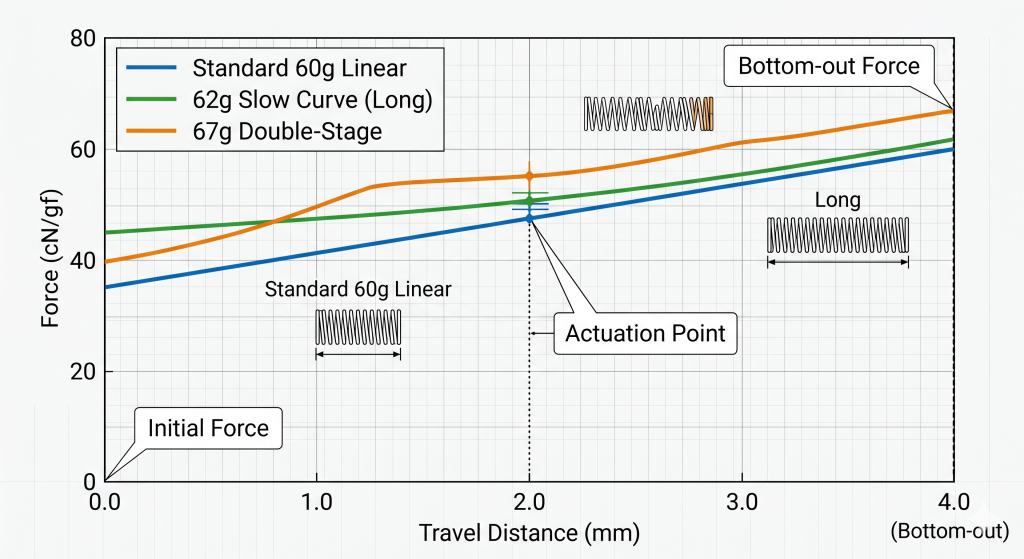
A Solution Architect relies on data to make decisions. In the realm of springs, that data is the “Force Curve.” There are three critical data points to consider for any viable spring swap:
Initial Force: The amount of weight required to begin moving the stem. A higher initial force prevents “accidental actuations” during high-stakes coding or gaming.
Actuation Force: The weight at the exact moment the electrical signal is sent. This is the “logic gate” of the switch.
Bottom-out Force: The weight at the end of the travel (usually 4mm). This is the most common metric used to categorize springs (e.g., 60g, 65g, 70g).
By understanding these nuances, you can select a spring that provides the immediacy required for rapid input without causing the finger fatigue that can hinder a long “coding sprint.”
:max_bytes(150000):strip_icc()/hookeslaw-58e2c81f3df78c5162206b1e.jpg)
3. Spring Variants: Architectural Differences
The market in 2026 offers a variety of spring architectures, each providing a unique tactile signature.
Standard Springs vs. Long Springs (Slow Curve)
Standard springs (14mm-15mm) follow a traditional linear path. Long Springs (18mm-22mm), however, are “pre-compressed” inside the switch housing. This results in a higher initial force and a “flatter” force curve. The sensation is often described as “snappy,” providing an immediacy in the return of the key that standard springs lack.
Multi-Stage Springs (Complex Logic)
Double-stage or triple-stage springs feature sections with different coil densities. This creates a non-linear resistance profile.
Stage 1: Soft initial entry.
Stage 2: A sudden increase in resistance before bottom-out.
This architectural complexity provides a unique “rebound” effect, which is highly prized by those who value a lively, energetic typing experience.
4. Material Nuance: Stainless Steel vs. Gold Plating
While the material has a minimal impact on the force curve, it is integral to the longevity and “acoustic health” of the switch.
Stainless Steel: The industrial standard. Reliable and consistent, it offers the structural integrity required for millions of cycles.
Gold Plated: Beyond the luxury aesthetic, gold plating is highly resistant to corrosion. In humid climates like Da Nang, this is a viable strategic choice to prevent the spring from developing “rust noise” or “crunchiness” over several years of use.
5. The Spring Swapping Protocol: Execution and Optimization
Replacing springs is a meticulous process that mirrors the deployment of a new software module.
Extraction: Open the switch housing using a dedicated opener, ensuring you do not damage the plastic clips.
Lubrication (The “Oil Bag” Method): As established in previous technical guides, springs must be lubricated to eliminate “ping.” Using an oil-based lubricant like Krytox 105 in a plastic bag remains the most efficient way to ensure an even, micro-thin coating across the entire ecosystem of springs.
Deployment: Place the new spring over the center pole of the bottom housing. Ensure it is perfectly vertical to maintain the structural integrity of the actuation path.
Verification: Close the switch and test for “crunch” or “ping.” The transformation in immediacy and resistance should be felt instantly.
6. The ROI of the Custom Weight: Reducing Biological Latency
Why does a student or professional developer care about the difference between a 62g and a 63.5g spring? The answer lies in the optimization of the human-machine interface.
If a spring is too heavy, it introduces “physical latency”—the time and energy it takes for your muscles to overcome the resistance. If it is too light, it leads to errors. By finding your “Personal Reference Weight,” you minimize the biological cost of typing. For an aspiring Solution Architect, this is about creating a “frictionless” environment. When your tools are tuned to your exact physical strength, you can maintain a “Flow State” for longer, allowing for deeper concentration on complex architectural designs or intensive exam preparation at FPT Polytechnic.
7. Strategic Swapping: Matching Springs to Switch Types
A common mistake is using the same spring weight across all switch types. There is a specific logic to matching:
Linear Switches: Often benefit from “Slow Curve” (Long) springs to provide a more consistent, “buttery” feel throughout the stroke.
Tactile Switches: Require careful spring selection. If a spring is too light, the stem may fail to overcome the tactile bump on the return, destroying the switch’s viability. A heavier, “snappier” spring often enhances the crispness of the tactile event.
8. Conclusion: Mastering the Force
Spring swapping is the ultimate refinement in the mechanical keyboard world. It is the process of taking a generic component and giving it a specific, intentional “weight” in your professional life. By mastering the architectural nuances of spring dynamics, you establish absolute dominance over your interface.
To elucidate the impact of this mod: it turns a keyboard into a tailored suit. It provides the structural integrity and immediacy required for the highest levels of professional performance. As you move toward your internship in September 2026 and your ultimate goal of a “Big Tech” career, let your perfectly weighted springs be a reminder that success is built on a foundation of precision, balance, and the relentless pursuit of optimization.
