Maintenance & Technical Guides
Soldering and Desoldering Mastery: The Low-Level Language of Hardware Persistence
May
In the hierarchical structure of computer technology, there exists a profound divide between those who consume interfaces and those who construct them. For a Solution Architect or a software engineer, mastering the architectural layers of a system is integral to long-term success. While “Hot-swap” technology has lowered the barrier to entry, the art of soldering remains the ultimate “Low-Level Language” of hardware. It is the process of creating permanent, high-fidelity electrical bonds that ensure the structural integrity and immediacy of every digital signal. This article will elucidate the rigorous techniques of soldering and desoldering, demonstrating why these skills are a viable and powerful asset in the professional ecosystem of 2026.
1. The Physics of the Solder Bond: Beyond Mere Adhesion
To a novice, soldering might appear to be a form of “gluing” metal. However, from a metallurgical perspective, it is a complex chemical reaction. When the solder—an alloy of tin and lead (or copper)—reaches its liquidus state, it performs “intermetallic bonding.” It literally merges with the surface of the copper pad on the PCB.
This bond is the bedrock of structural integrity. A well-executed solder joint provides near-zero electrical resistance, ensuring that the immediacy of your keystrokes is never compromised by “hardware-level latency.” For a student at FPT Polytechnic Danang aiming for a career at a “Big Tech” firm like Google, understanding this physical layer is the hardware equivalent of understanding memory management in low-level programming.
2. The Tooling Stack: Investing in Hardware Dominance
In software development, your IDE and compiler are your primary tools. In hardware maintenance, your “IDE” is your soldering station. Achieving absolute dominance over the PCB requires a specific technical stack:
Temperature-Controlled Soldering Iron: Precision is non-negotiable. An iron that cannot maintain a consistent thermal state will lead to “Cold Joints”—the hardware equivalent of a silent bug.
Flux (The “Optimizer”): Flux is a chemical cleaning agent that removes oxidation from metal surfaces. It facilitates the “flow” of solder, ensuring that the intermetallic bond is clean and robust. It is the integral catalyst that ensures the system’s viability.
The Solder Alloy: In 2026, while lead-free solder is more environmentally sustainable, many enthusiasts still prefer 63/37 Eutectic solder for its lower melting point and superior visual feedback (it turns shiny instantly upon solidifying).

3. The Soldering Protocol: A Systematic Execution
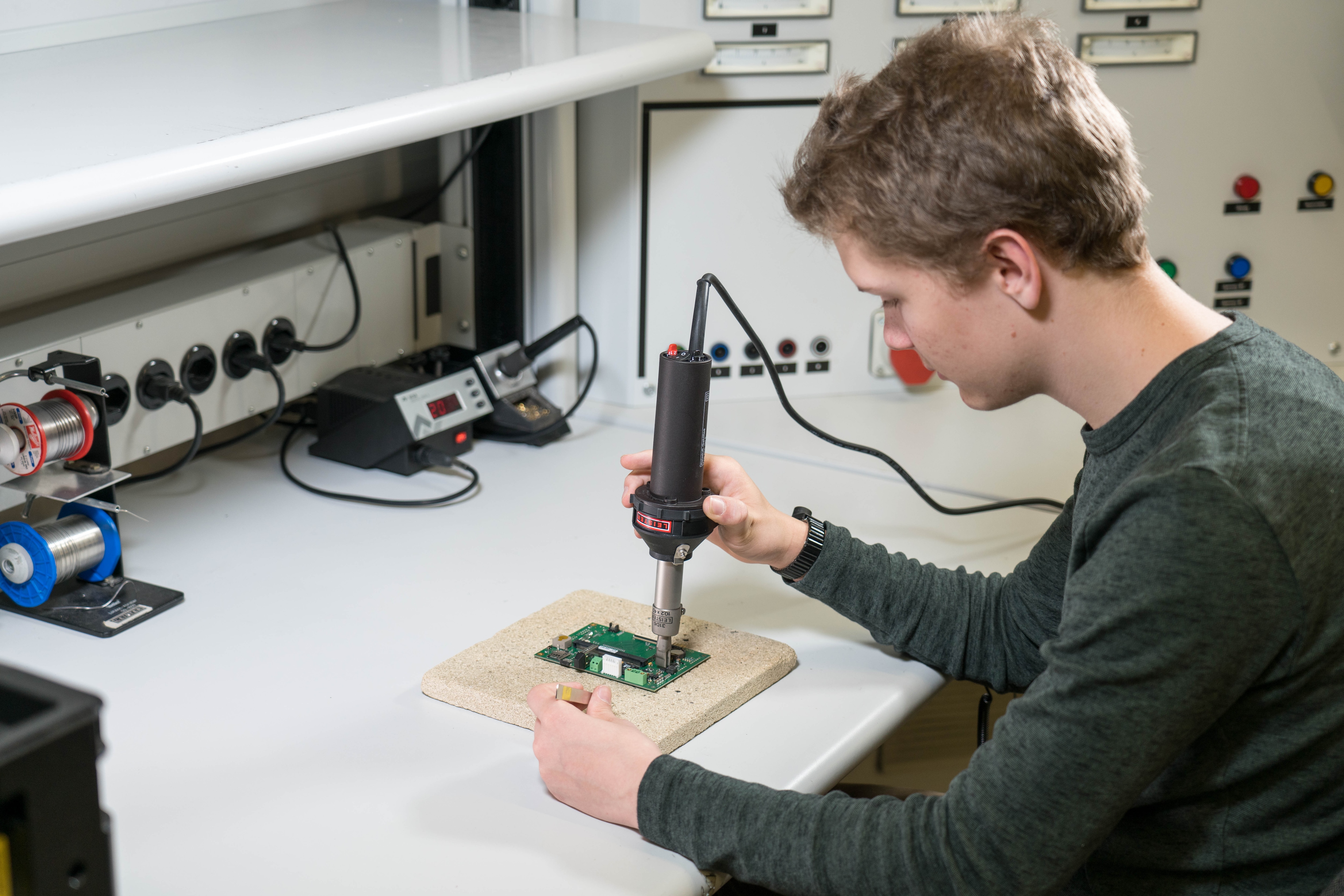
Soldering a keyboard matrix—typically consisting of 60 to 104 switches—requires a disciplined, iterative approach.
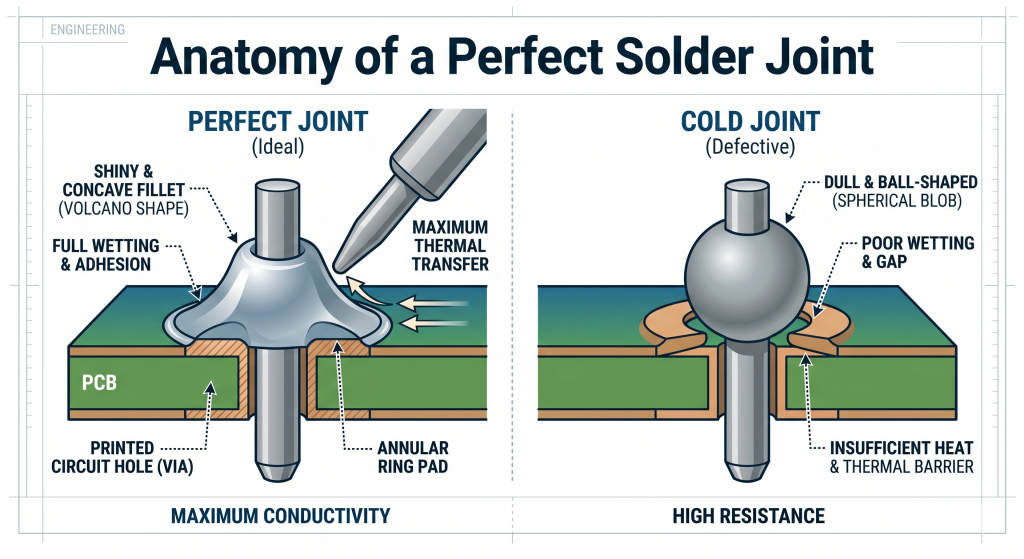
Thermal Preparation: Set the iron to approximately 330°C to 350°C. This temperature provides enough energy for rapid heat transfer without risking the structural integrity of the PCB’s delicate copper traces.
The Simultaneous Contact: Place the tip of the iron so it touches both the switch pin and the copper pad. This ensures even thermal distribution.
The Feed: Introduce the solder wire to the joint, not the iron tip. The heat of the components should melt the solder, allowing it to “wick” into the via through capillary action.
The Inspection: A perfect joint looks like a tiny, shiny volcano. If the joint is dull or spherical, it is a “failure node” that must be refactored.
4. Desoldering: The Hardware Equivalent of Refactoring
In software, we refactor code to improve its structure. In hardware, desoldering is the process of “undoing” a connection to replace a component or fix an error. This is significantly more difficult than soldering and represents a major paradigm shift in a technician’s skill level.
The Challenge of Thermal Mass
Desoldering requires removing all the old solder to free the component. This is often done using a Solder Sucker (vacuum pump) or Solder Wick (copper braid). The primary risk here is “Overheating the Pad.” If you apply heat for too long, the adhesive holding the copper pad to the fiberglass PCB will fail, leading to a “Lifted Pad”—a catastrophic hardware error.
Vacuum Desoldering Stations
For a professional Solution Architect, a dedicated vacuum desoldering gun is a viable investment. These tools combine an iron and a vacuum pump into a single unit, allowing for the immediacy of solder removal in a single trigger pull. This significantly reduces the risk of damaging the architectural layers of the PCB.
5. Safety and Environmental Nuance: Fume Extraction
Modern soldering involves the vaporization of flux and metals. These fumes contain colophony and other particulates that are harmful to the respiratory system. To maintain the viability of your long-term health, a Fume Extractor is an integral part of the workspace. This is the hardware equivalent of “Error Handling”—you must manage the hazardous “exceptions” produced by your work to ensure a sustainable environment.
6. The Solution Architect’s ROI: Complete System Mastery
Why should a 17-year-old student with a GPA of 3.96 and a focus on software development learn to solder? The answer lies in the concept of “Full-Stack Competency.”
A Solution Architect who understands the physical connection between a switch and a controller has a deeper, more nuanced understanding of latency, signal noise, and system reliability. When you prepare for your internship in September 2026, having “Soldering and Hardware Repair” on your resume will distinguish you as a candidate who doesn’t just write code, but understands the entire ecosystem that executes it. It shows a commitment to the structural integrity of every system you touch.
7. The Philosophy of “Right to Repair”
Mastering these skills is a powerful statement against the culture of disposable electronics. In 2026, sustainability is a core value in “Big Tech.” By repairing a broken keyboard or desoldering an old switch to give a board a new life, you are practicing “Hardware Resilience.” You are ensuring that your tools remain viable for decades, rather than months. This disciplined approach to maintenance and repair is the hallmark of a true master of systems.
8. Conclusion: The Architect of Permanent Bonds
Soldering is the final bridge between a collection of parts and a functional machine. It is a process that requires patience, precision, and a refusal to accept anything less than a perfect connection. By mastering the architectural challenges of thermal transfer and intermetallic bonding, you establish absolute dominance over your physical tools.
To elucidate the true impact of this skill: it gives you the power to create. You are no longer limited by what manufacturers sell you; you can build your own bespoke professional instruments. As you continue your studies at FPT Polytechnic, let your soldering skills be a reminder that in any great system—from a global cloud network to a 60% mechanical keyboard—the strength of the whole depends on the quality and integrity of its smallest connections.
