Versus & Comparisons
Custom vs. Pre-built: The Ultimate Architectural Decision for 2026
May
The mechanical keyboard industry has reached a fascinating crossroad. Over the past decade, we have witnessed a profound paradigm shift in how users perceive their primary input devices. What was once a niche hobby for enthusiasts has exploded into a multi-billion dollar market where the lines between “professional tools” and “gaming gear” are increasingly blurred. As a student at FPT Polytechnic Danang or a future Solution Architect, you are likely faced with the ultimate question: should you invest in the polished, feature-rich ecosystem of a Pre-built Gaming Keyboard, or venture into the deep, customizable world of Custom Mechanical Keyboards? This comprehensive analysis will elucidate the technical, ergonomic, and economic nuances of both paths to help you determine which is the most viable solution for your long-term career.
1. The Pre-built Powerhouses: Speed, Software, and Seamlessness
For many, the journey begins with names like Razer, Logitech, and SteelSeries. These brands have established a level of global dominance through massive R&D budgets and a focus on raw performance metrics that eSports professionals demand.
The Immediacy of Performance
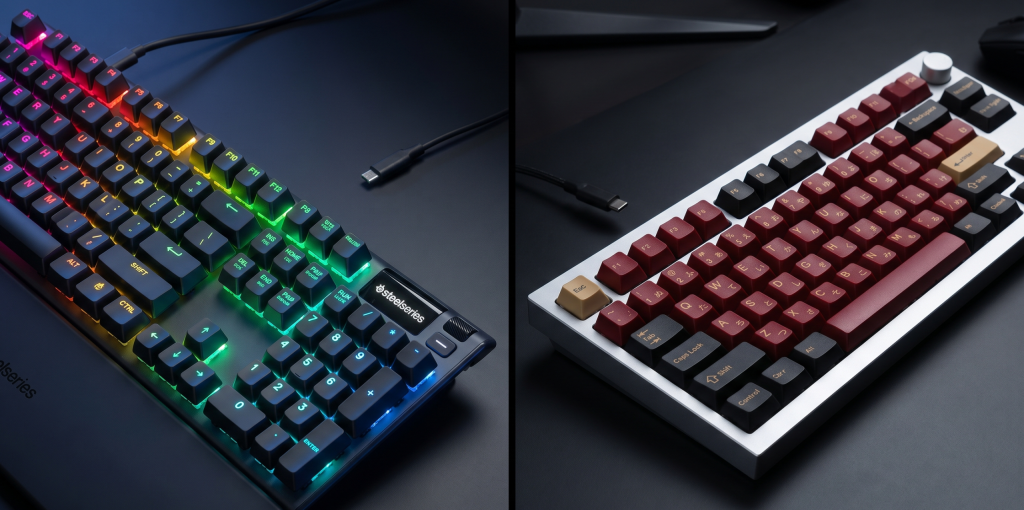
In competitive titles like Valorant or League of Legends, the concept of immediacy is paramount. Pre-built flagship keyboards have mastered this through technologies like Optical Switches and Hall Effect Magnetic Sensors. When every millisecond counts, the ability of a keyboard like the Razer Huntsman V3 Pro to register a keystroke at a 0.1mm actuation point provides a measurable mechanical advantage. This level of responsiveness is difficult to replicate in the custom world without specialized, high-cost components.
The Ecosystem Advantage
As an aspiring Solution Architect, you understand the value of an integrated tech stack. Pre-built keyboards come with sophisticated software suites—Razer Synapse, Logitech G Hub, or Corsair iCUE. These allow for seamless RGB synchronization across your entire desktop, cloud-based profile saving, and deep integration with in-game events. For the user who wants a “Plug-and-Play” experience that works flawlessly across a multi-monitor setup in a dorm room at FPT Polytechnic, the pre-built route offers unparalleled convenience.
2. The Custom Keyboard Renaissance: Artistry and Acoustic Perfection
On the other side of the spectrum lies the “Custom” world, led by brands like Keychron, Glorious, and Akko. This path is not about raw speed, but about the architectural integrity and the sensory experience of typing.
Sound Engineering and “Thock”
The most significant nuance of a custom keyboard is its sound signature. Enthusiasts spend hundreds of dollars and dozens of hours tuning their boards to achieve the elusive “Thock”—a deep, resonant sound that signifies high-density materials and perfect lubrication. Unlike the hollow, plastic sounds often found in mass-produced gaming boards, a custom-built Keychron Q Series utilizing a gasket-mount design and high-quality poron foam offers a level of acoustic satisfaction that can make long coding or writing sessions significantly more enjoyable.
Total Hardware Autonomy
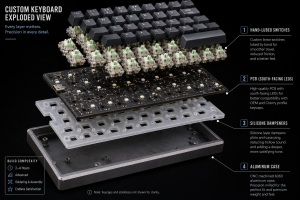
The true dominance of the custom world lies in its Hot-Swappable nature. You are not merely a consumer; you are the architect. You can choose the specific weight of your springs, the material of your plate (Polycarbonate for flex, Brass for stiffness), and the texture of your PBT keycaps. If a switch fails, you don’t throw the keyboard away; you simply swap the component. This modularity makes custom boards a more sustainable and viable long-term investment for a professional career.
3. Software Logic: Proprietary vs. Open-Source
One of the most critical areas to elucidate is the firmware controlling the hardware. This is where your interests in Software Development and hardware collide.
Proprietary Software (The “Gardened Wall”): Brands like Logitech provide beautiful, user-friendly interfaces. However, they are often resource-heavy, requiring background processes that can impact system performance. If you switch to a Linux machine or a locked-down office computer, you may lose access to your macros and lighting profiles.
QMK/VIA (The Open-Source Freedom): Most high-quality custom boards support QMK/VIA. This is a firmware architecture where the logic is saved directly to the keyboard’s EEPROM. Once you program your layout, it lives on the hardware forever. For a developer who values technical control and cross-platform compatibility, the logic of QMK/VIA is far more robust and viable.
4. Ergonomics and Workspace Sustainability
Whether you are studying at FPT Polytechnic Danang or working a 9-to-5 job, ergonomics is an integral part of your health.
Pre-built Boards: Often focus on a “standard” layout. While they include wrist rests and adjustable feet, they can sometimes be bulky.
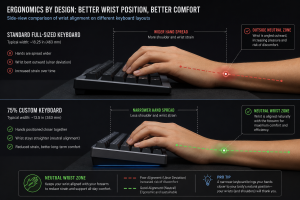
Custom Boards: Allow for specialized layouts like 75%, 65%, or even Alice/Arisu (Split) designs. These layouts keep your mouse closer to your center of gravity, reducing shoulder strain. For a student spending 8+ hours a day on a laptop or desktop, the ergonomic nuances of a 75% layout like the Keychron V1 can prevent long-term wrist fatigue.
5. Economic Viability: Cost vs. Longevity
We must address the economic nuances of this decision.
A flagship Pre-built (e.g., Corsair K100) costs approximately $250. You get everything in one box, but if the internal PCB fails or the non-standard keycaps wear out, the entire unit is often rendered useless.
A Custom starter kit (e.g., Keychron V Series) might cost $80, plus $50 for switches and $30 for keycaps, totaling $160. While the upfront cost of a truly high-end custom (like the Q Series) can exceed $300, every single part is replaceable. In the long run, the custom board is the more viable financial decision because it evolves with you. You can “refactor” your hardware just like you refactor your code—improving it incrementally over time.
6. The Solution Architect’s Final Verdict
Choosing between these two paths is an exercise in prioritizing your requirements.
The Pre-built Path is the dominant choice for those who:
Require absolute immediacy and raw speed for competitive gaming.
Value a polished, unified software ecosystem that “just works” out of the box.
Want the latest cutting-edge features like Hall Effect sensors and OLED screens.
The Custom Path is the dominant choice for those who:
View their keyboard as a professional tool for coding and writing, where acoustic and tactile feel are paramount.
Value open-source QMK/VIA firmware for total control over their hardware logic.
Seek a sustainable, modular investment that can be customized and repaired for years to come.
In 2026, there is no wrong answer, but there is a logical one based on your specific needs. As you continue your journey through FPT Polytechnic and toward your goal of becoming a Solution Architect, remember that your keyboard is your primary interface with the digital world. Invest in a tool that not only reflects your skills but also enhances your daily efficiency and comfort.
