Brand Legacy & Market Impact
Keychron: The Great Unifier and the Democratization of the Custom Keyboard Experience
May
In the historical timeline of computing peripherals, the era between 2015 and 2020 will likely be remembered for a massive paradigm shift in keyboard culture. Before this period, the market was bifurcated: one could either purchase a mass-produced gaming keyboard or spend thousands of dollars and months of waiting on an enthusiast-level custom “group buy.” Keychron, a relatively young startup, emerged as the primary architect of a middle ground, establishing a new level of market dominance by acting as a bridge. This article will elucidate Keychron’s legacy, exploring how its focus on structural integrity, macOS compatibility, and open-source logic has ensured its viability as the modern professional’s tool of choice.
1. The Kickstart of a Revolution: Identifying the Gap
Keychron’s impact on the market was not an accident; it was a calculated response to a neglected demographic. While giants like Logitech and Razer were engaged in an “RGB arms race,” Keychron identified two critical voids: the lack of high-quality mechanical options for macOS users and the high barrier to entry for the custom keyboard hobby.
By launching through crowdfunding platforms, Keychron built a direct relationship with its community. This strategy allowed them to bypass traditional retail bottlenecks and iterate on their hardware logic with unprecedented speed. For a student at FPT Polytechnic Danang or a future Solution Architect, Keychron serves as a lesson in agile development: they didn’t just build a product; they built a feedback loop that allowed them to scale their ecosystem with surgical precision.
2. Bridging the OS Divide: The macOS Pioneer
For years, Mac users were forced to choose between the aesthetic minimalism of the Magic Keyboard or the clunky, Windows-centric design of mechanical boards. Keychron’s first major paradigm shift was the inclusion of dedicated macOS media keys and a physical toggle switch for OS compatibility.
This seemingly small nuance was actually an integral part of their success. By providing a “Mac-first” experience without sacrificing mechanical performance, Keychron captured the hearts of developers, designers, and creatives. This focus on inclusivity ensured that their keyboards became a staple in modern co-working spaces and high-end tech offices, proving that viability in a niche market is the first step toward global dominance.
3. The Architecture of Accessibility: From K-Series to Q-Series
The evolution of Keychron’s product line is a masterclass in tiered architectural design.
The K-Series (The Gateway): These boards introduced the masses to wireless mechanical typing, offering a variety of form factors (from 60% to 100%) in a lightweight, budget-friendly package.
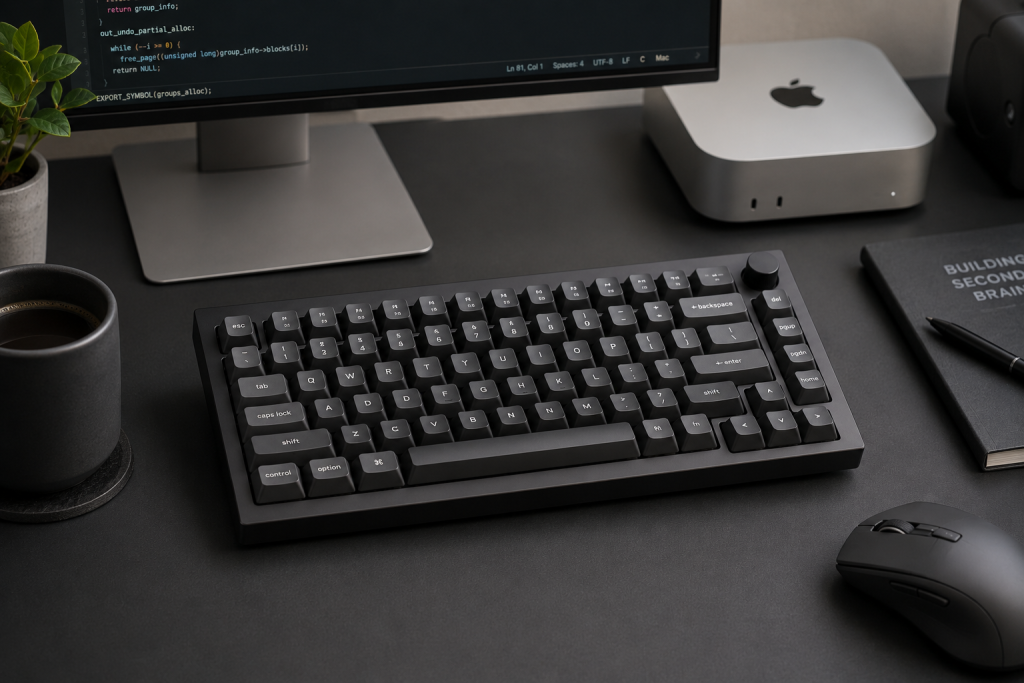
The Q-Series (The Enthusiast Flagship): Keychron later orchestrated a move toward premium quality with the Q-Series. Featuring full CNC-machined aluminum bodies, gasket-mount designs, and double-shot PBT keycaps, these boards provided the structural integrity of a $400 custom kit at less than half the price.
By creating this “Product Ladder,” Keychron ensured that users could enter their ecosystem at any price point and gradually “upgrade” their experience as they learned more about the hobby.
4. The Logic of Open-Source: QMK and VIA Integration
As someone aiming for a career as a Solution Architect, you can appreciate the power of standardized, open-source firmware. Keychron’s decision to support QMK and VIA across almost their entire Pro and Max lineups was a technical paradigm shift.
Unlike proprietary software suites that can be resource-heavy or platform-dependent, QMK/VIA allows for hardware-level programmability. This ensures that the immediacy of your custom macros and layers is preserved regardless of whether you are working on a Windows server, a Linux terminal, or a macOS workstation. This commitment to “Firmware Freedom” is a vital nuance that appeals to the developer community, making Keychron an integral tool for those who view their keyboard as a programmable extension of their logic.

5. Technical Nuance: The South-Facing LED and Hot-Swap Standard
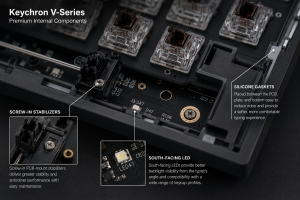
Keychron was one of the first major brands to popularize “South-facing” LEDs in the mainstream market. This is a subtle but critical piece of architectural engineering. Traditional North-facing LEDs can cause physical interference with high-end, “Cherry profile” keycaps. By re-orienting the PCB, Keychron ensured that their hardware was compatible with the entire world of enthusiast-grade keycaps.
Furthermore, by making Hot-Swappability a standard feature rather than a luxury, Keychron empowered users to “refactor” their typing experience. If a user decides they prefer a tactile “bump” over a linear “glide,” they can simply swap the switches without needing a soldering iron. This modularity is a hallmark of viable modern design, emphasizing repairability and long-term personalization.
6. Market Impact: Forcing the Giants to Adapt
The most telling sign of Keychron’s dominance is how they have forced legacy brands to change their strategies. In 2026, we see companies like Razer and Logitech finally incorporating enthusiast features like gasket mounts, pre-lubed switches, and standard bottom rows—features that Keychron has been championing for years.
Keychron’s legacy is defined by its role as a “Market Educator.” They took the complex, intimidating world of custom keyboards—with its nuances of plate materials, foam densities, and stabilizer tuning—and made it accessible to anyone with a USB-C port. They proved that a keyboard could be a high-performance tool and a work of industrial art without requiring a massive financial sacrifice.
7. The Wireless Convergence: Redefining Connectivity Logic
The evolution of Keychron’s “Max” and “Pro” series further elucidates the brand’s mastery of wireless immediacy. In the early days of mechanical keyboards, wireless connectivity—primarily via Bluetooth—was often viewed with skepticism by the developer community due to inherent latency and connection drops. This made wireless boards an un-viable solution for high-stakes environments where every millisecond of input is integral. Keychron orchestrated a significant paradigm shift by moving beyond simple Bluetooth pairing.
By integrating 2.4GHz wireless technology with a 1,000Hz polling rate into their latest models, Keychron achieved a level of immediacy that was previously reserved for wired gaming flagships. This technical nuance reflects an architectural understanding of the modern professional’s workflow: the need for a “Clean Desk” aesthetic without the compromise of input lag. For a student at FPT Polytechnic or a future Solution Architect, this represents a perfect synthesis of form and function, ensuring that the hardware remains a reliable node within a complex digital ecosystem.
8. Hardware as an Agile Repository: The Iterative Development Model
Perhaps the most fascinating aspect of Keychron’s market dominance is their adoption of “Agile” methodologies within the traditional manufacturing sector. In software development, we value rapid iteration and continuous feedback loops; Keychron has applied this exact logic to their architectural design process. Instead of adhering to rigid, multi-year product cycles, Keychron maintains a “living repository” of hardware designs. They monitor enthusiast forums and subreddits with surgical precision, treating user feedback as a primary data source for their next “sprint.”
This agility allowed them to quickly integrate high-end features—such as double-gasket mounts, screw-in stabilizers for enhanced structural integrity, and acoustic foam—into their budget-friendly V-series. By treating hardware development like a software release cycle, Keychron ensures that their products are always at the cutting edge of market nuance. This “Hardware-as-a-Service” mindset is what keeps the brand’s viability high, as it proves they are not just selling a static tool, but an evolving interface that grows alongside the technical demands of its global community.
