Brand Legacy & Market Impact
The Razer Phenomenon: How “For Gamers. By Gamers.” Defined an Industry
May
In the vast ecosystem of modern technology, very few brands have managed to transcend their status as mere hardware manufacturers to become cultural icons. In the world of gaming peripherals, Razer stands as the ultimate testament to this achievement. Since its inception in the late 1990s, the brand has orchestrated a profound paradigm shift, moving the industry away from generic office beige toward the neon-green, high-performance aesthetic that defines gaming today. This article will elucidate the architectural evolution of the Razer legacy and analyze the strategic dominance that allows it to maintain its viability in an increasingly crowded market.
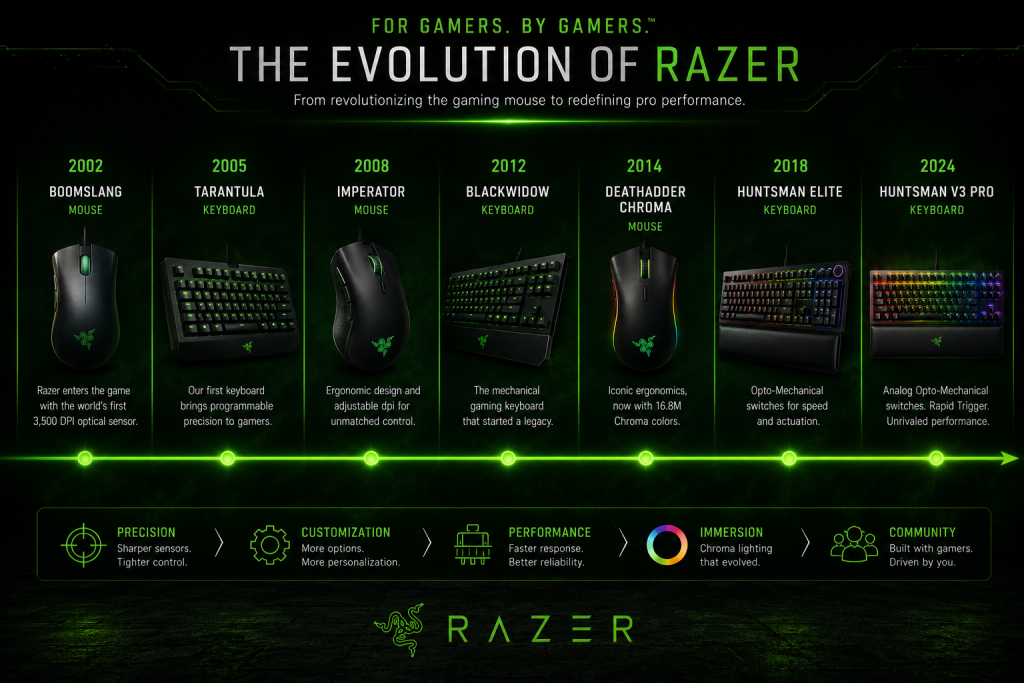
1. The Genesis: The Razer Boomslang and the Birth of eSports
To understand Razer’s market impact, one must look back to 1999. At a time when the world was using “ball mice” with limited precision, Razer introduced the Boomslang. It was a high-DPI, ergonomically radical device that promised a level of immediacy in response that was previously unthinkable.
This wasn’t just a new product; it was a statement. Razer identified a growing demographic—the competitive gamer—that the “Big Tech” companies of the time were ignoring. By focusing on raw performance and a specialized “gaming-first” design, Razer provided the integral tools that early eSports pioneers needed to compete. This early focus on professional gaming established a structural integrity for the brand that continues to provide it with marketing dominance today.
2. The “Cult of Razer”: Building a Lifestyle Ecosystem
Razer’s most significant market impact is perhaps not its hardware, but its branding. The slogan “For Gamers. By Gamers.” is one of the most successful examples of community-focused marketing in tech history.
The Psychology of the Three-Headed Snake
Razer didn’t just sell mice and keyboards; they sold an identity. By sponsoring early pro-gamers and creating a “Cult of Razer” through limited-edition drops and community events, they ensured that their logo became synonymous with the gaming lifestyle. As a student of Software Development, you can recognize this as a masterclass in user retention and brand loyalty. Once a user enters the Razer ecosystem, the psychological “switching cost” becomes high because the brand feels like a part of their personal identity.+++_
Diversification and Market Reach
Razer’s legacy is not confined to the desk. They have successfully diversified into laptops (the Razer Blade series), apparel, and even financial services with Razer Gold. This diversification ensures the brand’s viability across different economic sectors, making it more than just a peripheral company—it is a lifestyle ecosystem that touches every aspect of a gamer’s digital and physical life.
3. The RGB Revolution: Chroma and Visual Dominance
It is impossible to discuss Razer’s impact without mentioning Razer Chroma. Before Razer, RGB lighting was often seen as a tacky gimmick. Razer turned it into a sophisticated, programmable software layer that defined the “gaming aesthetic.”
Software Architecture as a Competitive Moat
From a technical perspective, Razer Synapse and Chroma represent a significant architectural achievement. By allowing developers to integrate in-game events directly with the hardware’s lighting (e.g., your keyboard flashing red when your health is low), Razer created a deeper level of immersion. This immediacy of visual feedback became an integral part of the gaming experience. It also created a “locked-in” effect: once you have invested time in customizing your Chroma profiles, moving to a competitor’s software feels like a loss of creative effort.
4. Technical Innovation vs. Marketing Prowess
Razer often faces criticism for being “more marketing than substance,” but a deep dive into their engineering reveals a consistent drive for nuance in performance.
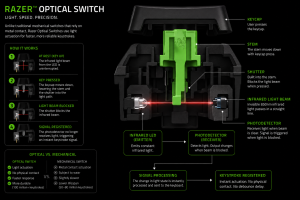
Optical Switch Integration: Razer was among the first to bring optical switches to the mainstream market with the Huntsman series. By replacing mechanical contacts with light sensors, they eliminated debounce delay, providing the immediacy that competitive gamers crave.
HyperPolling Technology: Their 8,000Hz polling rate technology pushed the boundaries of how fast a peripheral can communicate with a PC. While the actual benefit to a casual user might be minimal, the dominance of having the “fastest” specs on the box is a vital part of Razer’s market strategy.
5. The Competitive Landscape: Surviving the “Custom” Paradigm Shift
In recent years, the rise of custom mechanical keyboards (like Keychron and Glorious) has challenged Razer’s dominance. The market has shifted toward a desire for better acoustics (“thock”) and architectural modularity (hot-swappability).
Razer’s response has been a fascinating example of market adaptation. With the release of the BlackWidow V4 75% and the Huntsman V3 Pro, Razer has begun incorporating enthusiast-level features:
Factory-lubed switches.
Gasket-mount-like feel.
Standardized bottom rows for keycap customization.
This shift shows that Razer is aware of the changing nuances in user preference. They are no longer just competing with Logitech; they are competing with the entire custom keyboard community. Their ability to adapt their massive manufacturing scale to these niche preferences is what makes them a viable leader for the next decade.
6. The Solution Architect’s View: Scalability of the Razer Model
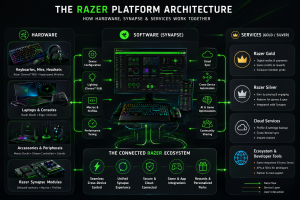
If we analyze Razer as a system, its scalability is impressive. They have built a hardware-software-service stack that is incredibly difficult for newer companies to replicate.
Hardware: High-performance, recognizable design.
Software (Synapse): The glue that binds the hardware to the user’s desktop.
Services (Razer Gold/Silver): The economic layer that keeps users engaged through rewards and currency.
This “Triple-Threat” architecture is why Razer remains the dominant force in the industry despite intense competition. They don’t just sell a product; they manage a platform.
Final Verdict: A Lasting Legacy
Razer’s impact on the market cannot be overstated. They took a hobby that was considered “geeky” and turned it into a global phenomenon with a premium aesthetic. While purists may prefer the acoustics of a custom board, the viability of Razer’s high-performance, ecosystem-driven model is undeniable.
As you navigate your path toward becoming a Solution Architect, Razer serves as a powerful case study in how to build a brand that is both technically integral and emotionally resonant. They have mastered the nuance of the gaming market, ensuring that the three-headed snake remains the most recognized logo in the world of pixels and polygons.
Thank you!
