Versus & Comparisons
Keychron V Series vs. Glorious GMMK 2: The Gateway to Custom Keyboard Dominance
May
In the rapidly evolving world of computer peripherals, we are currently witnessing a profound paradigm shift. The days when high-quality mechanical keyboards were reserved for those willing to spend $400 on a group buy are officially over. A new category of “Entry-level Enthusiast” boards has emerged, establishing a new level of dominance in the market. Two of the most significant contenders in this space are the Keychron V Series (specifically the V1 and V3) and the Glorious GMMK 2. This exhaustive analysis will elucidate the technical nuances and architectural differences between these two platforms to determine which represents the most viable starting point for your custom keyboard journey.
1. Architectural Philosophy and Case Construction
The structural integrity of a keyboard is the foundation upon which all other performance metrics are built. For a student of Software Development, comparing these two is akin to comparing two different software frameworks: one built for flexibility and the other for streamlined performance.
Keychron V Series: The Translucent Workhorse
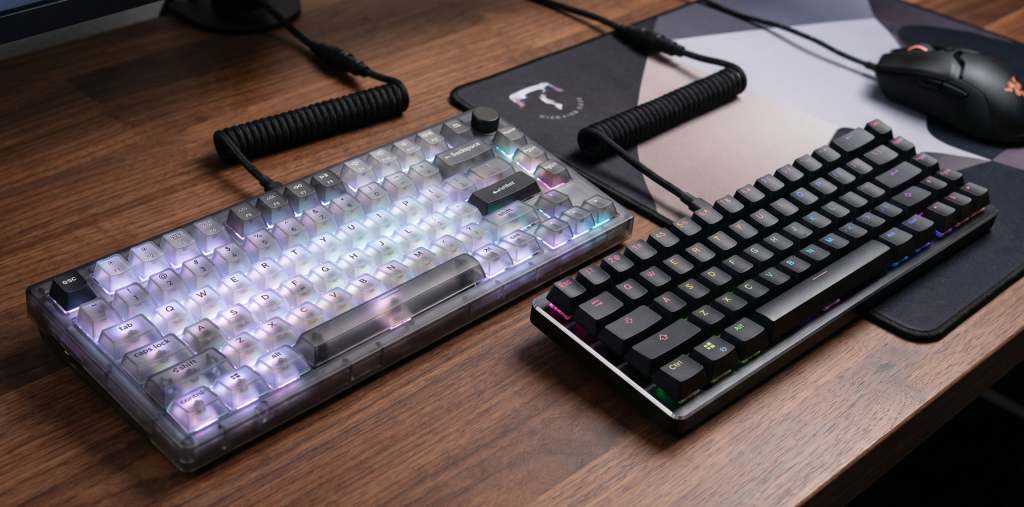
The Keychron V Series ($79 – $99) utilizes a solid ABS plastic housing. However, this is not the cheap plastic found in budget office boards. It is a thick, reinforced shell that often comes in a translucent “Frosted Black” finish, allowing a glimpse into the internal integral components. The V Series uses a tray-mount design, but with a modern twist: it includes silicone gaskets and high-quality screw-in stabilizers that are typically reserved for much more expensive custom kits. This results in a heavy, stable platform that feels intentional and premium.
Glorious GMMK 2: The Hybrid Minimalist
The Glorious GMMK 2 ($79 – $119) takes a different approach, utilizing a “sandwich mount” design with a brushed aluminum top plate and a plastic bottom case. This creates a much lower profile aesthetic. The GMMK 2 feels incredibly stiff and rigid, which many gamers prefer for the immediacy of feedback. However, from an acoustic standpoint, the thinner aluminum plate can sometimes lead to a “pingy” sound if not properly dampened—a technical nuance that enthusiasts often spend hours trying to fix.
2. The PCB and Hot-Swap Ecosystem: A Technical Deep Dive
For a future Solution Architect, the PCB (Printed Circuit Board) is the most critical subsystem. It dictates the logic and compatibility of the entire hardware stack.
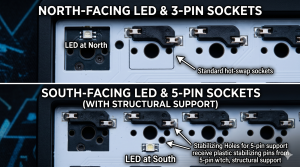
Keychron’s South-Facing Dominance: One of the most important technical advantages of the Keychron V Series is its South-facing LEDs. In the world of custom keyboards, “North-facing” LEDs (where the light is at the top of the switch) can cause physical interference with high-end Cherry profile keycaps. By orienting the LEDs toward the user (South), Keychron ensures 100% compatibility with all enthusiast-grade keycap sets, such as those from GMK.
Glorious GMMK 2 Compatibility: The GMMK 2 uses a 5-pin hot-swap PCB, which is excellent for stability. However, many versions still feature North-facing LEDs. While this results in brighter RGB through “shine-through” legends, it creates a compatibility bottleneck for users who want to explore premium keycaps. This is a vital nuance to consider if your long-term goal is total hardware customization.
3. Software Architecture: QMK/VIA vs. Glorious CORE
In your career in software development, you will often have to choose between proprietary and open-source solutions. These two keyboards represent that exact choice.
The Power of QMK/VIA (Keychron)
The Keychron V Series is powered by QMK firmware and is fully compatible with VIA. This is an open-source, industry-standard configuration tool. It allows you to remap every single key, create complex macros, and even program specialized functions like “Space-Fn” layers directly onto the keyboard’s EEPROM. Because the logic is saved on the hardware, you can plug the keyboard into any machine at FPT Polytechnic or a future “Big Tech” office, and your settings will remain exactly as you left them, without needing to install any software.
The Streamlined Experience of Glorious CORE
Glorious utilizes its own proprietary software, Glorious CORE. While it is much more user-friendly for beginners and offers a beautiful UI for adjusting RGB lighting, it lacks the deep, multi-layered logic found in VIA. Furthermore, CORE must be installed on the host PC to make changes, making it a less viable solution for developers who frequently switch between different operating systems or secure environments.
4. Internal Sound Engineering and Acoustics
The “Sound Signature” is what separates a toy from a tool.
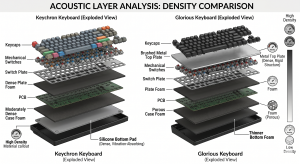
Keychron’s Dampening Logic: The V Series comes packed with sound-dampening foam and a thick silicone pad at the bottom of the case. This is designed to eliminate “hollowness” and produce the coveted “thocky” sound. For a student focusing on long coding sessions, a deeper, quieter acoustic profile is often more conducive to concentration.
Glorious’s Acoustic Challenge: Due to its thinner profile and aluminum top plate, the GMMK 2 has a brighter, more “clacky” sound. While Glorious has added some internal foam, it doesn’t quite match the density of the Keychron. However, for a gamer who wants the immediacy of every click to be heard clearly, the GMMK 2’s sharper sound profile can be an advantage.
5. Aesthetics, RGB, and Desk Integration
While performance is integral, the visual dominance of your setup cannot be ignored.
Glorious GMMK 2 Lighting: Glorious is the clear winner in the RGB department. The GMMK 2 features lateral “side-lighting” strips that cast a beautiful glow onto your desk mat. If you want a keyboard that acts as the visual centerpiece of a high-end gaming setup, the GMMK 2 is hard to beat.
Keychron V Series Professionalism: Keychron opts for a more sober, professional look. The RGB is “South-facing,” meaning it glows more brilliantly between the keys toward the user, but it lacks the side-lighting flare of the Glorious. It is a design that says “I am here to work,” which may appeal more to a future Solution Architect.
6. Value Proposition and Market Viability
When we look at the price-to-performance ratio, both boards offer incredible value, but for different users.
The Keychron V Series is essentially a “Custom Starter Kit” in a pre-built form. It teaches you about screw-in stabilizers, QMK firmware, and South-facing PCB logic. It is a viable long-term investment because every part of it is standard and replaceable.
The Glorious GMMK 2 is a “Gaming-Enthusiast Hybrid.” It gives you the speed and aesthetics of a gaming board but with the build quality of a custom board. It is the perfect choice for the user who wants a premium experience out of the box without diving too deep into the complex world of firmware programming.

7. Final Verdict: Which Path to Customization?
The choice between the Keychron V Series and the Glorious GMMK 2 depends on where you want your journey to lead.
Choose the Keychron V Series if:
You want the most professional, enthusiast-grade foundation with South-facing LEDs.
You value the open-source power of QMK/VIA for complex workflow automation.
You prefer a deeper, “thockier” acoustic profile for long typing and coding sessions.
Choose the Glorious GMMK 2 if:
You want a sleek, low-profile aesthetic with superior RGB side-lighting.
You prefer a stiff, rigid typing feel for the immediacy of gaming inputs.
You want a user-friendly, “plug-and-play” software experience via Glorious CORE.
In conclusion, both boards have successfully established their dominance in the entry-level market. Whether you choose the technical flexibility of Keychron or the aesthetic brilliance of Glorious, you are taking a significant step toward mastering your hardware ecosystem—a vital step for any future Solution Architect.
