Maintenance & Technical Guides
The Ultimate Maintenance Checklist: A Perfect Strategic Roadmap for Hardware Lifecycle Management
May
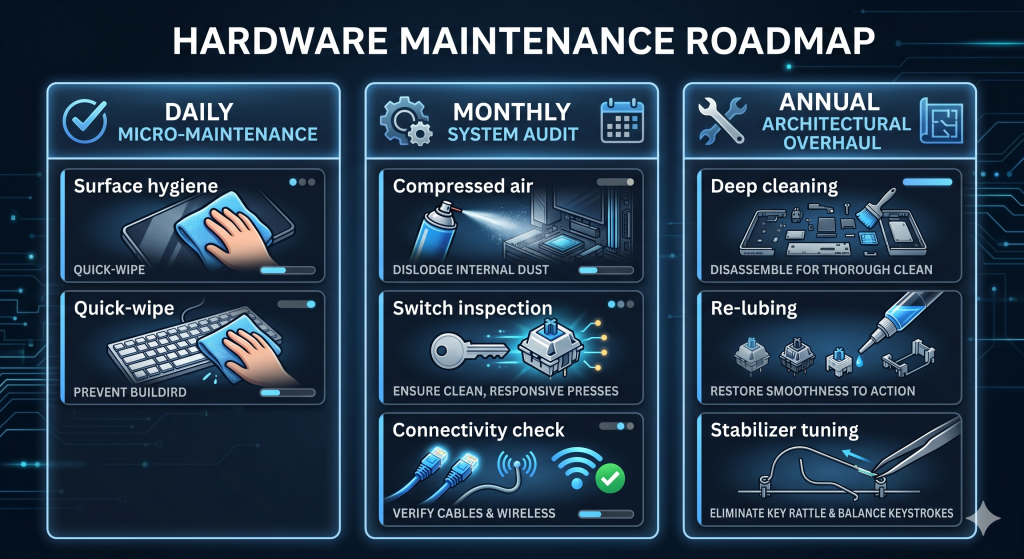
In the sophisticated world of enterprise software, the transition from “Deployment” to “Maintenance” is where the true value of a Solution Architect is revealed. A system that lacks a rigorous audit protocol is a system destined for catastrophic failure. Translating this logic to the physical realm, your mechanical keyboard is a high-performance infrastructure that requires more than occasional cleaning. It demands a systematic “Lifecycle Management” strategy. To maintain absolute dominance in your digital workspace and ensure the immediacy of your inputs, you must implement a multi-tiered maintenance framework. This article will elucidate the Ultimate Maintenance Checklist, providing a viable roadmap to preserve the structural integrity and performance of your technical ecosystem in 2026.
1. The Philosophy of the Audit: Preventing Hardware Technical Debt Ultimate
In software engineering, “Technical Debt” accumulates when we prioritize speed over quality. In hardware, debt accumulates through the slow ingress of dust, the migration of lubricants, and the oxidation of electrical contacts. For a 17-year-old student at FPT Polytechnic Danang aiming for a career at a “Big Tech” firm like Google, the discipline of the “Hardware Audit” is integral to professional growth.
By treating maintenance as a scheduled “System Audit,” you perform a paradigm shift from being a reactive user to a proactive architect. You are no longer “fixing” problems; you are optimizing the viability of your primary interface to ensure it remains a reliable node within your digital ecosystem.

2. Tier 1: The Daily Micro-Maintenance (The “Smoke Test”)
In software, a “Smoke Test” is a quick check to see if the basic functions work. Your daily maintenance should be equally swift and focused on maintaining immediate immediacy.
Surface Sanitization: Use a microfiber cloth to remove the skin oils and micro-debris accumulated during your daily coding or gaming sessions on your ASUS ROG Strix G16. This prevents the “shining” of keycaps and preserves the tactile nuance of the plastic.
Debris Firewall: A 10-second blast of compressed air or a quick brush between the keys prevents dust from becoming an integral part of the switch’s internal mechanics.
Visual Integrity Check: A quick glance to ensure no keycaps are loose and the RGB (if used) is functioning correctly across the entire matrix.
3. Tier 2: The Monthly System Audit (The “Sprint Review”)
Every month, as you review your academic progress and GPA at FPT Polytechnic, you should also review the state of your hardware.
Connectivity Integrity: Inspect the USB-C port and cable. Dust inside the port can lead to intermittent signal loss, destroying the immediacy required for competitive gaming in titles like Valorant or Counter-Strike 2.
Keycap “Shine” Audit: For those using ABS keycaps, check for the first signs of texture degradation. If the structural integrity of the surface is compromised, consider a localized cleaning with higher-concentration isopropyl alcohol.
Deep Air Evacuation: Use a more powerful vacuum or electric duster to clear the “hollow” spaces beneath the keycaps that a daily brush cannot reach.
4. Tier 3: The Quarterly Architectural Overhaul (The “Major Release”)
Every three to four months, your system requires a deep intervention—the hardware equivalent of a “Version 2.0” update.
Step 1: Interface Layer Sanitization (Keycaps)
Remove all keycaps using a wire puller to protect the stems. A full wash in warm, soapy water is mandatory to remove deep-seated oils that have migrated into the legends and undersides.
Step 2: Stabilizer Health Audit
As elucidated in our previous guides, stabilizers are the most vulnerable parts of the ecosystem.
Check for Rattle: If the Spacebar or Enter keys have developed a “tick,” the grease has likely migrated.
Syringe Maintenance: Use a small syringe to re-inject a viable amount of dielectric grease or XHT-BDZ into the stabilizer housings to restore silence and immediacy.
Step 3: Switch Consistency Testing
Perform a “Typing Audit” using software to detect “key chatter” (double-clicking). If a switch is failing, its structural integrity is compromised, and it must be replaced or repaired before it becomes a bottleneck in your workflow.
5. Tier 4: The Annual Hardware Refactor (The “Legacy Support”)
Once a year, as you prepare for your next career milestone—such as your internship in September 2026—you should perform a total system refactor.
PCB Oxidation Inspection: Open the case and inspect the PCB for any signs of moisture damage or corrosion, especially in Da Nang’s humid climate. Restoring a trace with a jumper wire (as taught in Article 25) is a viable way to extend the board’s life by years.
The Re-Lubing Cycle: Lubricants like Krytox 205g0 eventually dry out or collect enough dust to become abrasive. An annual “re-lube” of your primary switches ensures that the “buttery” smoothness and nuance of your board remain at peak levels.
Spring Replacement Audit: If you feel the keys have lost their “snap,” the structural integrity of the springs may have weakened. An annual spring swap is an integral part of maintaining the “Force Curve” you’ve optimized for your hands.
6. Environmental Optimization: Designing for Resilience
A true Solution Architect doesn’t just fix the system; they design the environment to prevent failure.
Climate Control: Using a dehumidifier in your workspace is a strategic move to preserve the copper traces on your PCB.
Storage Logic: If you own multiple boards (like an iPad Pro M4 keyboard for travel and a custom board for home), ensure they are stored in dust-proof sleeves. This preserves their viability while they are “offline.”
The “Clean Desk” Paradigm: Reducing environmental dust through regular room cleaning is the most effective “Firewall” for your keyboard.
7. The Professional ROI: Hardware Mastery as a Career Advantage
Why should a software developer invest so much time in a “Maintenance Checklist”? The answer lies in the psychology of professional discipline.
A Solution Architect who manages their physical tools with the same precision they apply to a cloud architecture is a professional with a higher “Level of Excellence.” When you interview at a “Big Tech” firm, your ability to explain the architectural maintenance of your tools demonstrates a nuanced understanding of reliability and longevity. It shows that you do not just “use” technology—you master it. This level of dedication is integral to maintaining a GPA of 3.96 and eventually dominating the competitive landscape of the global tech industry.
8. Conclusion: The Eternal Architect
The Ultimate Maintenance Checklist is the final piece of the puzzle. It connects the “how-to” of modding with the “why” of professional sustainability. By mastering the nuances of daily, monthly, and yearly audits, you establish absolute dominance over your digital environment.
To elucidate the true value of this final guide: it ensures that the “perfect” keyboard you built in Bài viết số 1 stays perfect. By protecting the structural integrity and immediacy of your hardware, you ensure that your interface with the digital world is always fast, silent, and flawlessly responsive. As you move toward your internship in September 2026 and your future as a world-class Solution Architect, let this checklist be your manual for excellence. You have learned to build, you have learned to optimize, and now you have learned to preserve. The system is complete.
