Brand Legacy & Market Impact
SteelSeries: The Danish Vanguard and the Magnetic Revolution of Hall Effect Technology
May
In the global theater of eSports and peripheral engineering, very few brands have managed to maintain a consistent reputation for pioneering innovation as successfully as SteelSeries. Founded in Denmark in 2001, the company has acted as a vanguard for competitive gaming, orchestrating a significant paradigm shift in how players interact with their hardware. While others focused on aesthetic vanity, SteelSeries focused on the raw logic of input speed and structural integrity. This article will elucidate the brand’s legacy, exploring how its commitment to “Danish Design” and the invention of magnetic actuation have ensured its long-term viability and market dominance.
1. The Copenhagen Genesis: Building the Foundation of eSports
The story of SteelSeries began not with a keyboard, but with a fundamental solution to a technical problem. In the early 2000s, competitive gaming was in its infancy, and players struggled with inconsistent surfaces. SteelSeries (originally known as Soft Trading) launched the Icemat and SteelPad—the first mousepads designed specifically for gamers. This early focus on professional-grade tools established the brand’s DNA: identifying a bottleneck in performance and architecting a solution to remove it.
This “Solution-Oriented” mindset is what allowed the brand to transition into mechanical keyboards. Their early 6G and 7G models were legendary for their structural integrity, using high-grade materials that could withstand the intense physical stress of a professional tournament. For a student at FPT Polytechnic Danang studying Software Development, this serves as a reminder that the most successful systems are built on a robust, reliable foundation before any complexity is added to the “UI.”
2. The OmniPoint Paradigm Shift: Mastering Magnetic Logic
The most profound impact SteelSeries has had on the market is the introduction of the OmniPoint switch. For decades, the industry was bound by the mechanical limitations of Cherry-style switches—physical metal contacts that dictated a fixed actuation point. SteelSeries recognized that this was a technical constraint that hindered the immediacy of player input.
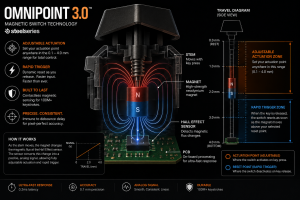
By utilizing Hall Effect sensors, SteelSeries replaced physical contacts with magnetic fields. This was more than just an incremental improvement; it was a total paradigm shift in keyboard architecture.
Variable Actuation: Users could software-program the actuation point of every single key, ranging from a hair-trigger 0.1mm to a deep 4.0mm.
Rapid Trigger: By sensing the magnet’s position in real-time, the keyboard could reset the key the millisecond the user began to lift their finger.
For competitive players in titles like Valorant or Counter-Strike 2, this provided a level of immediacy in movement—such as counter-strafing—that traditional mechanical boards simply could not replicate. The viability of this technology was so absolute that it forced every other major brand to scramble and develop their own magnetic alternatives.

3. The Architecture of the SteelSeries Ecosystem
A great product is only as strong as the system that supports it. SteelSeries has built a comprehensive ecosystem through its SteelSeries GG software suite. This software is not merely a configuration tool; it is a sophisticated control center that manages the “Input Logic” of the hardware.
Sonar Audio Suite: By integrating professional-grade parametric EQ into the software, SteelSeries allows users to “architect” their soundstage, highlighting specific frequencies like footsteps in games.
Engine Integration: The seamless synchronization between the Apex keyboards and the Arctis headsets creates a unified sensory environment.
As an aspiring Solution Architect, you can see how SteelSeries uses software to increase the “switching cost” for the user. Once you have fine-tuned your actuation points and audio profiles within the GG ecosystem, moving to a competitor feels like a significant loss of personalized efficiency. This is a classic example of dominance through system integration rather than just individual hardware sales.
4. Danish Minimalism: Function over Flash
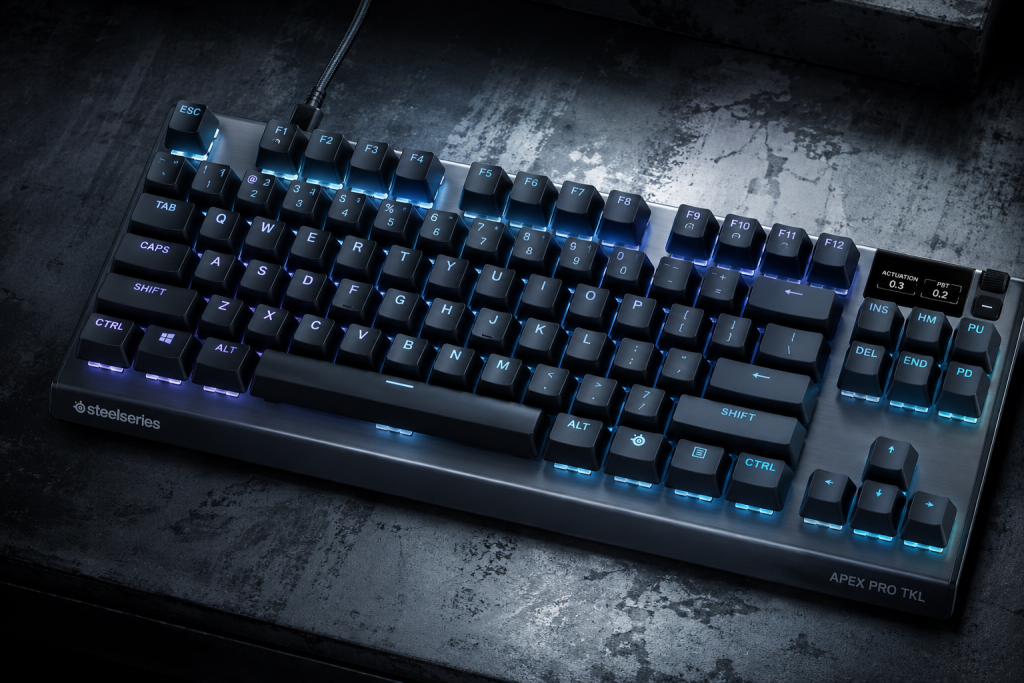
While brands like Razer embraced a neon-green “Gamer” identity, SteelSeries remained true to its Scandinavian roots. Their design language is characterized by clean lines, premium materials like aircraft-grade aluminum, and a minimalist footprint. This aesthetic choice is integral to their market strategy: a SteelSeries keyboard looks just as at home in a high-end Solution Architect office at Google as it does on a main stage at a Major tournament.
This focus on minimalism extends to their ergonomics. By pioneering the “TKL” (Tenkeyless) movement and the even smaller 60% layouts, SteelSeries empowered gamers to reclaim desk space for their mice, proving that in high-stakes competition, “Less is More.” The nuance in their keycap spacing and the angle of their chassis reflects a brand that understands the long-term physical demands of the user.
5. The Professional eSports Synergy
SteelSeries’ legacy is inextricably linked to the history of professional eSports teams like SK Gaming, Fnatic, and FaZe Clan. They didn’t just sponsor these teams; they used them as “Quality Assurance” testers. This feedback loop ensured that every product was battle-tested before reaching the consumer.
The immediacy and reliability required to win a $1,000,000 prize pool are the same standards SteelSeries applies to its consumer products. This commitment to professional standards ensures the brand’s viability in a market where consumers are increasingly savvy about performance metrics. When a pro player uses an Apex Pro to win a world championship, it provides a level of marketing dominance that no traditional advertisement can match.
6. The Developer’s Logic: Programmability and Persistence
From a Software Development perspective, SteelSeries hardware is a playground of logic. The ability to bind complex macros and multiple actuation layers is a dream for developers who want to optimize their workflow.
Layering Logic: You can program a key to act as a normal character when tapped, but as a modifier or a macro when held—all controlled by the magnetic precision of the switch.
Cross-Platform Persistence: SteelSeries ensures that these logical configurations can be saved directly to the keyboard’s on-board memory, making them viable across different operating systems without needing to re-install software.
This technical nuance is why many developers who are also gamers gravitate toward the brand. It is a tool that respects the user’s intelligence and provides the granular control necessary for a high-level digital workflow.
7. Conclusion: The Magnetic Future of SteelSeries
SteelSeries has proven that the key to lasting dominance is the courage to abandon legacy technology in favor of a superior logical framework. By mastering the paradigm shift from mechanical to magnetic actuation, they have redefined the expectations of the entire industry.
