Brand Legacy & Market Impact
Akko: The Aesthetic Disruptor and the Democratization of the Premium Experience

May
In the high-velocity world of technology, market dominance is usually reserved for legacy titans with decades of history. However, Akko, founded in Shenzhen in 2016, has orchestrated one of the most rapid and significant paradigm shifts in the history of peripheral hardware. By identifying a critical gap between overpriced “gaming” gear and inaccessible “custom” kits, Akko has established itself as the primary architect of the “Aesthetic-Performance” hybrid. This article will elucidate Akko’s legacy, analyzing how its commitment to structural integrity, vertical integration, and design nuance has made premium typing a viable reality for the global masses in 2026.
1. The Strategy of Vertical Integration: Architecture of Value
Akko’s impact on the market is fundamentally rooted in its architectural independence. Unlike many mid-range brands that act as mere assemblers—buying switches from one vendor and cases from another—Akko pursued a strategy of total vertical integration. They built their own factories to produce keycaps, switches, and chassis.
For a student of Software Development at FPT Polytechnic, this is an incredible case study in system optimization. By controlling the entire supply chain, Akko eliminated the “middleman” markup. This allowed them to invest more in the structural integrity of their products. They introduced heavy, dual-layer PCBs and high-quality internal dampening materials into keyboards that cost half as much as their “Big Tech” competitors. This focus on internal logic and manufacturing efficiency is what ensured Akko’s long-term viability in a saturated market.
2. The Keycap Revolution: Mastering the Tactile Nuance
If Cherry gave the world the switch, Akko gave the world the “Profile.” Before Akko, high-quality PBT keycaps in non-standard shapes were incredibly expensive. Akko recognized that the keycap is the most integral touchpoint between the human and the machine.
They developed the ASA Profile—a proprietary hybrid that combines the height of the classic Spherical (SA) profile with the ergonomic curves of the OEM profile. This was a true paradigm shift in user experience design. By providing a larger surface area and a more sculpted feel, Akko provided a level of typing immediacy and comfort that was previously unthinkable at a budget price point. This attention to ergonomic nuance is why Akko boards are frequently recommended for developers who spend hours architecting complex codebases and require a fatigue-free interface.

3. The CS Switch Series: Redefining Input Logic
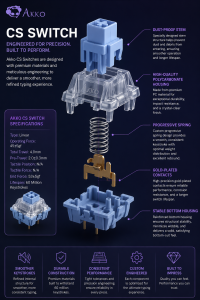
Akko’s dominance was further cemented by the release of its Custom Series (CS) switches. While other brands were content using generic clones, Akko’s engineers designed switches with specific spring weights and actuation points tailored to different user behaviors.
Akko CS Jelly Black: Provided a heavy, linear “glide” for those who value structural integrity in every press.
Akko CS Lavender Purple: Offered a tactile “bump” with high-positioned actuation, delivering the immediacy required for rapid data entry.
By creating their own “Logic of Actuation,” Akko proved that they were not just a fashion brand, but a serious engineering firm. They made the viability of “enthusiast-grade” switches a standard feature rather than a luxury upgrade.
4. Hardware as Fashion: The Aesthetic Paradigm Shift
Akko’s most visible impact is its refusal to accept the “Black or White” status quo of the industry. They treated keyboard design as a form of “Industrial Art.” Through their “World Tour” series and collaborations with iconic anime franchises like Sailor Moon and Dragon Ball Z, Akko transformed the keyboard into a lifestyle statement.
This strategy elucidated a profound market truth: in 2026, the digital workspace is an extension of one’s identity. By offering a vast ecosystem of themes—from the minimalist “Dolch” to the vibrant “Tokyo”—Akko ensured that every user, from a high-school gamer to a senior Solution Architect, could find a board that resonated with their personal aesthetic. This focus on “Visual Logic” allowed Akko to dominate social media platforms, creating a brand dominance that traditional advertising could never achieve.
5. Technical Accessibility: The Multi-Mode Standard
Akko was a pioneer in bringing “Tri-Mode Connectivity” to the mainstream. While legacy brands were still charging premiums for basic Bluetooth, Akko made the combination of 2.4GHz wireless, Bluetooth 5.0, and USB-C a standard feature across their lineup.
This technical viability is integral for the modern professional. Whether you are using your keyboard with an ASUS ROG Strix G16 for development or an iPad Pro M4 for quick notes, Akko’s seamless switching logic provides the immediacy required in a multi-device ecosystem. For a student aiming to maintain a high GPA while juggling various projects, this versatility is not a luxury; it is a fundamental requirement for productivity.
6. The Developer’s Logic: Modularity and Repairability
As someone pursuing a career in Software Development, you likely value “Clean Code” and modularity. Akko’s hardware reflects these values through its commitment to Hot-Swappable PCBs.
By making it easy to replace a single switch or customize the internal foam, Akko turned the keyboard into an “Open Source” piece of hardware. This encourages a “Maintenance Mindset” rather than a “Disposable Mindset.” The structural integrity of their hot-swap sockets—designed to withstand hundreds of swaps—ensures that the keyboard remains a viable tool for a decade. This modularity is a vital nuance that appeals to the “Big Tech” philosophy of long-term system sustainability.

7. The Solution Architect’s Final Verdict: A System of Balance
From a system design perspective, Akko is a masterclass in “Optimization of the Mid-Range.” They have proven that you do not need to sacrifice structural integrity to achieve a competitive price point.
By mastering the paradigm shift toward enthusiast features and aesthetically-driven hardware, Akko has forced the entire industry to raise its standards. They have shown that a successful ecosystem is one that is inclusive, modular, and visually inspiring.
8. Conclusion: The Master of the New Era
Akko’s legacy is defined by its role as the “Great Democratizer.” They took the elite nuances of the custom world—the gasket mounts, the pre-lubed switches, and the designer keycaps—and made them an integral part of the consumer experience.
To elucidate Akko’s true impact: they made the keyboard “personal” again. By mastering the structural integrity of their components and the logic of their vertical integration, they have ensured their dominance for years to come. As you prepare for your internship in September 2026 and work toward your dream of becoming a Solution Architect at a company like Google or Facebook, let Akko serve as your inspiration: always look for the “Logic of Beauty” and never settle for a system that isn’t as capable as it is inspiring.
